Secrets of the Fundamentalists
Things I Discovered During My Decades in Fundamentalism and Beyond
by J. R. Lee, B.S. (Physics maj.), M.A. in Philosophy

Entries were originally posted on my Facebook page on the dates shown. If you've had a Facebook experience similar to mine, you know how challenging it can be to locate content you are actually looking for. Here you can find all my Secrets of the Fundamentalists posts in newest to oldest order.
83. A case for knowing history vs absolute truth - 2 September 2026
As I have intimated previously, the fundamental issue I have with Fundamentalism is its anti-intellectualism.
I sometimes refer to (Protestant Christian) Fundamentalism and the qualifier is merely because that is the fundamentalist culture that I was a true-believer in for some score years. All fundamentalisms though share a belief in the absolute truth of whatever their core beliefs are. So, whereas Protest Christian Fundamentalists have their own particular beliefs, it is not these per se that I take issue with, it is rather the shutting off of ones mind to think for oneself when it comes with these beliefs. I encourage the reader to review previous postings of mine for elaboration at:
secrets-of-the-fundamentalists.jrlee27.net
---
On 4 June 2026 I began reading Klosko's academic tome 'The Oxford Handbook of the History of Political Philosophy' (OHBHPP); I finished up its eight-hundred some pages on 22 August. The image I've attached shows my copy with the flags I've attached to mark points of particular interest. You can see Klosko's Table of Contents at:
academic.oup.com/edited-volume/34508
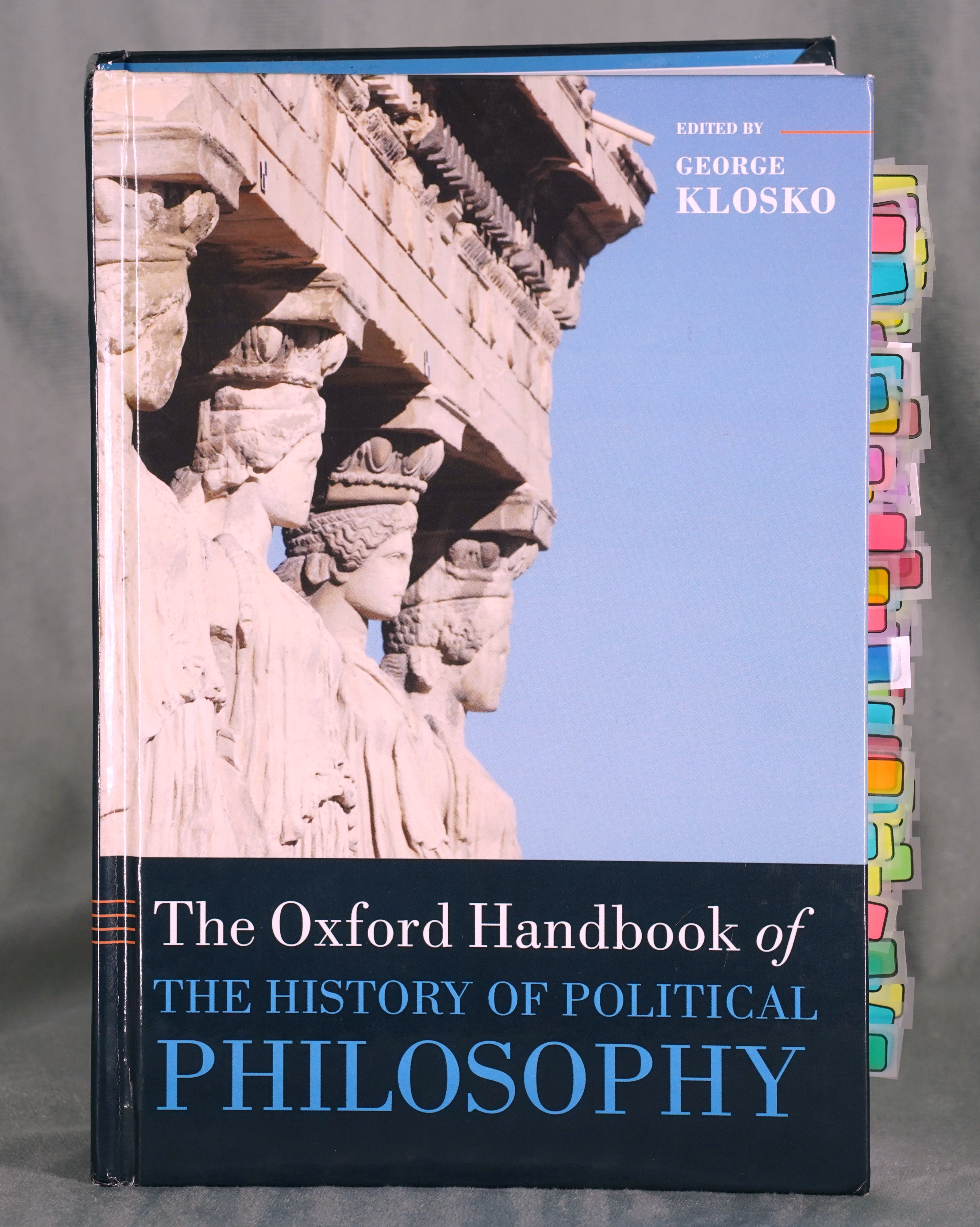
Anyway, the motivation for my reading Klosko was to approach a better comprehension of (surprise) political philosophy. Social media (including Facebook) in particular is a gawd-awful place to try to understand politics and searching on the www is limited. So many people sharing so many opinions which seems to me whoever is saying whatever (left, right, up, down, whatever) comes from a place where they feel they have the absolute truth. In other words, fundamentalists--whether they identify with the term or not.
Before I embarked on my read of Klosko I had just read John Rawls' 'A Theory of Justice (Rev. Ed.)' a remarkable thesis (not totally foreign to the Golden Rule) in a difficult five-hundred page book. Anyway it was fundamentalist postings that annoyed me enough that I decided to read Rawls (FWIW, I doubt the vast majority of fundamentalists have any idea who Rawls was--I had heard of Rawls in my own separate studies). Some way into Rawls I came to the feeling that Rawls was a pivotal figure in the history of political philosophy, in other words, there was before-Rawls and after-Rawls. Many scholars regard Rawls somewhat similarly. While I've been exposed to political philosophy working on my MA in Philosophy, I hadn't a survey course in it and I felt the need; so I identified Klosko as a means to survey that material.
While not really a wake-up call for me, I hadn't applied it to political philosophy formally, that if you want to approach knowing your stuff (if I want to approach knowing my stuff), you (I) should study the history and not just some cherry-picked works of the moment. And, if you don't really know your stuff, you should think twice about sharing your opinions (or parroting someone else's).
--fin
82. "Unskilled and Unaware of It", the Dunning-Kruger Effect as it applies to Fundamentalism's handling of the Bible. - 21 August 2026
In my last installment of Secrets of the Fundamentalists, I had rhetorically posited the question, "Absolute truth of overweening confidence in oneself?" As I don't imagine myself to possess absolute truth, I continued to research the theme of that posting. My research effort was rewarded by discovering the work done by Justin Kruger and David Dunning (both Cornell) that they describe in their 1999 Journal of Personality and Social Psychology paper, "Unskilled and Unaware of It: How Difficulties in Recognizing One's Own Incompetence Lead to Inflated Self-Assessments". The observation of their research has become known as the "Dunning-Kruger Effect" and I offer this excerpt from the article abstract as descriptive:
"People tend to hold overly favorable views of their abilities in many social and intellectual domains. The authors suggest that this overestimation occurs, in part, because people who are unskilled in these domains suffer a dual burden: Not only do these people reach erroneous conclusions and make unfortunate choices, but their incompetence robs them of the metacognitive ability to realize it."
If (Protestant Christian) Fundamentalism is anything, it is an institutionalized form of anti-intellectualism--they close their mind and senses to anything that challenges their institutionalized beliefs. Their hostility to science may be obvious to the world, but the hostility extends as well to the Bible itself (!) where their modus operandi is not objective exegesis (drawing out its meanings), but rather subjective eisegesis (putting in their meanings). This substitution of actual Bible content with their teachings (doctrine, orthodoxy, dogma) (obviously) permits profound ignorance of the Bible but paradoxically a vastly inflated opinion of their knowledge of the Bible.
Think of Unskilled and Unaware of It, the Dunning-Kruger Effect whenever anyone says, "It's simple, the Bible is clear on this matter," whatever that matter is.
--fin
81. Absolute truth or overweening confidence in oneself? - 18 August 2026
In answering the question Why is it that you believe what you believe, How solid does the response sound that one believes what they believe because they have heard *one* viewpoint very convincingly presented and they don't need to look into anything else because they have the truth?
Of course, the way the Protestant Christian Fundamentalists I know may imagine it may be more like this,
"I believe what I believe because the Spirit of God has convicted me of my sin and revealed salvation through the Lord Jesus Christ to me and I know this is the absolute truth?"
You know, Protestant Christian Fundamentalists aren't the only Fundamentalists in the world, while each strain of Fundamentalist have their own notions of what the absolute truth consists of, what makes each strain Fundamentalist is that they believe in some absolute truth that keeps them from reflecting on what they believe and considering that they may be wrong. This isn't a question of *what* they believe, it is a question of misplaced confidence in oneself. One shouldn't be so confident in oneself that one won't critically review their beliefs from time to time using the best challenging resources available.
--fin
80. Cognitive dissonance in Christian Nationalism - 28 July 2026
Cognitive dissonance is defined by Merriam-Webster as psychological conflict resulting from incongruous beliefs and attitudes held simultaneously. I posit that it is the desire to resolve the conflict that is behind much of the Christian Nationalist movement.
Flag-waving patriotism has been a feature in much of American Protestant Christian Fundamentalism. This is so despite the facts (1) that the KJV states in James 4:4: “Ye adulterers and adulteresses, know ye not that the friendship of the world is enmity with God? whosoever therefore will be a friend of the world is the enemy of God.” and (2) America is part of that world.
The Constitution of the United States is America’s law of the land and has not a hint of religiosity in it, but by hook or by crook Christian Nationalists are striving to arrogate its secular nature through a strained mythologizing that has it that as the founders and/or the then culture were Christian that the Constitution should be interpreted by Christian lights anyway. It seems to me that some critical examination is warranted rather than the strained mythologizing.
--fin
79. Time to wean - 18 July 2026
Back in the day, when I was still a Fundamentalist, pastors when they spoke on 1 Corinthians 3:1-2 (KJV),
"And I, brethren, could not speak unto you as unto spiritual, but as unto carnal, even as unto babes in Christ. I have fed you with milk, and not with meat: for hitherto ye were not able to bear it, neither yet now are ye able." ,
lamented that they could not get into the 'meat of the word' implying that they'd like to, but as there was a failing with the flock, they couldn't. I herein offer as an alternative interpretation rather that the message is that the flock's failing is that they haven't pulled away from mother's breast (the pastors) and set out to interpret the 'word' for themselves.
Look at it. Think about it. Not Fundamentalism.
--fin
78. On Politics - 12 July 2026
I herein assert, that when it comes to what you believe as an individual
human being, the reason you believe something is more important than
that thing you believe.
Fundamentalism appeals to and nurtures those who are content to be low
-information. "Salvation is as simple as A-B-C." "There's only one
issue you need to consider when you vote." Etc.
But the world is more complicated than that.
As John Stuart Mill observed, if you really want to be informed you
need to consider all sides and that from each side's besr
representatives. You won't get it from any Fundamentalist and you won't
get it from Social Media either--it's too cherry-picked and
algorithmized and oftentimes corrupted.
I have no respect for anyone of whatever persuasion they are if they are
not willing to do their homework and be open to the possibility that it
could change their mind. On the other hand, do your homework and
whatever you come up with, I'll at least give you a nod.
This year I decided to get more serious about my own news consumption.
One periodical I've started reading is 'Foreign Affairs'. I like it
because the essays therein "shall be competent and well-informed,
representing honest opinions seriously held and convincingly expressed"
while "tolerat[ing] wide differences of opinion" (https://www
.foreignaffairs.com/about-foreign-affairs). Indeed in its consumption,
I've found that I've had to adjust a view or two of my own one way or
another--this stuff ain't simple.
Since I am mentioning the media, it'd be worth your time to take a look
at the Media Bias Chart at https://adfontesmedia.com/ to see where
various news sources fall on their 'News Value and Reliability' versus
'Bias' chart.
--fin
77. On AI - July 2026
I recently made a car trip out of state and elected to read Professor
Melanie Mitchell's audiobook 'Artificial Intelligence: A Guide for
Thinking Humans' enroute. For me there weren't any great revelations as
I am a technical person (Physics major and MA in Philosophy from
Cleveland State University) keeping up to date on Artificial
Intelligence (AI) currents and I found it reassuring that what she said
did not catch me unaware in any significant way. For someone who would
like an introduction to what AI is I think Mitchell's book is
satisfactory. It's about 9 1/2 hours duration.
Setting aside Mitchell though I would like to share a few thoughts on
AI.
1. Multiple Facebook users on my feed have stated having consulted AI. That's fine, but you should realize that there are multiple AI incarnations in the world. These can be distinguished in a number of different ways such as what is the code that is being run, but I think probably more significantly is how it was trained.
2. Much training data is entered by (surprise) humans. Yes, frail humans. And these humans have to be paid which can limit the amount of data used for training to budget constraints.
3. And training data can be culturally biased (selected) by who was funding the training, say America, France, or China. Or Free-thinkers, Authoritarians, or you get the idea.
4. Not all human knowledge is finding its way into AI, indeed I think most of the most valuable stuff isn't as it is copyright and otherwise restricted. On the other hand, if the AI is harvesting data from, say, Facebook, a lot of tripe would be finding its way into AI.
5. Of course, many versions of the Bible are freely available and can be used to train AI incarnations. Now imagine a church attendee getting home after service puzzled over what their preacher said and asking their AI what the Bible says about whatever it is. It's so easy and the AI could give you book, chapter, and verse. I think AI has the potential to reveal (hopefully!) that the Fundamentalist claim to be Bible-believing is exaggerated. This isn't because AI is a higher quality source of information than what has gone before (it isn't), but rather that it is so easy for the lazy to use.
--fin
76. On Israel - 1 July 2026
Over the past several months I've seen postings (and shares) from Facebook Friends manifesting strong feelings on Israel both for and against. I will not be joining the fray, but here I will be sharing a few observations on "Israel" that some may not be heedful of. Note, there's much more that can be said on this topic, but I am writing a Facebook post not a dissertation.
1. Whatever present-day Israel is, per Genesis the 'nation' of Israel consisted of twelve tribes descended from the 'man' Israel (formerly Jacob).
2. The twelve tribes eventually formed two kingdoms, ten tribes made up the Northern Kingdom, Israel; two tribes, the Southern Kingdom, Judah.
3. Circa 720 BCE (Wikipedia) per 2 Kings 17:6 the people of the Kingdom of Israel were removed by the Assyrians from the land of Israel. They never returned. They are gone. They are 'the lost ten tribes'.
4. 'Jew' is a term denoting a descendancy from the people of the Kingdom of Judah.
5. Jews are descendants of the man Israel but they do not make up the entirety of the Kingdom of Israel that existed up through the time of 2 Kings 17:6.
Three differences between present-day Israel and the Kingdom of Israel:
6. The Jews of present-day Israel are descendants of the people of the Kingdom of Judah rather than the entire ancient kingdom.
7. Over 20% of Israeli citizens are Arabic (Wikipedia) and most are not converts to the Jewish religion.
8. Present-day Israel has a unitary parliamentary republican form of government (Wikipedia); it is not a kingdom. As such the government is elected by the people (not decreed from the Lord God) and not all its citizens will be in agreement with it.
You should note, that calling something something, does not make the former something into that latter something. Present-day Israel is not one and the same entity as the ancient kingdom of Israel.
(Note, it is not my purpose to persuade you to be of one mind or another on the Middle-East; rather my purpose is to persuade you to do your research and think critically about these matters, indeed all matters.)
--fin
75. Faith-beliefs as disclosures - 22 May 2026
As discussed previously the essential characteristic of faith-belief is the lack of evidence. Indeed, the only way that speaking of one's strong faith can make sense is that one knows that evidence is lacking but yet they believe whatever it is anyway. That being the case, that faith-belief cannot be demonstrated by evidence, what one has faith-belief in is disclosure to what that person wants to believe rather than what has evidence supporting it.
Given the preceding, what a person decides to believe from the Bible is what they want to believe and is an expression of who they are.
Now the Christian New Testament plainly has Jesus saying the following:
"Therefore all things whatsoever ye would that men should do to you, do ye even so to them: for this is the law and the prophets." Matthew 7:12 (KJV)
"And as ye would that men should do to you, do ye also to them likewise." Luke 6:31 (KJV)
It seems curious then that many Fundamentalists believe in condemning broad swaths of humanity on account of many things: nation, race, religion, politics, etc., and they will assert that these attitudes are based on the Bible.
If the foregoing passages of Jesus are to mean anything, one needs to put oneself into the shoes of the other (whoever that may be) and consider how they would like to be treated.
On the other hand, the Bible also has various narratives, such as the Israelite massacre of people Jericho (Joshua 6), which Fundamentalists view as a triumph. It seems the believer has a choice to channel the compassion of Jesus expressed above or the bloodlust in the Jericho narrative. In either case, as these are faith-beliefs they are disclosures of what the believer wants to believe.
--fin
74. "The sluggard is wiser in his own conceit than seven men that can render a reason." - 7 May 2026
The above referenced passage from Proverbs 26:16 from the KJV Bible is presenting a contrast between two subjects, "the sluggard" and "seven men that can render a reason." The sluggard is defined by the contrast to the seven men who can render a reason--the sluggard cannot (render a reason); the reason being, that he is a sluggard, that is, lazy--he has not done the thinking to arrive to that point. But, what he has, because he has not done the mental work, is an overarching opinion of his opinions--he is wiser in his own conceit. Some in some situations would call this faith.
The conceit is baked into Fundamentalism with notions like, "God said it, I believe it, that settles it", or revelation via the Holy Spirit, or all good godly men believe this way. Parrots.
The only way you can expect to be able to render a reason rather than parroting something someone told you is if you dig in and study for yourself and that includes, interestingly enough, exposing yourself to contrasting viewpoints. You've got to wonder about sincerity of anyone who tells you not to, but yet, that's what I've heard from Fundamentalists.
--fin
73. I'd rather be, and be treated like, a reasoning human than a dumb sheep. - 7 April 2026
Fundamentally, Fundamentalism is an anti-intellectual movement. The Fundamentals (what Protestant Christian Fundamentalist call their traditional Articles of Faith) do not rank anywhere near in importance to their opposition to individual (critical) thinking. By that I mean that a completely different set of Fundamentals could be substituted for the traditional set and they would still be Fundamentalists because of their expectation of slavish belief in whatever the Fundamentals are would remain unchanged. Thus conditioned it would be surprising if this conditioning did not spread throughout a Fundamentalist's mind to other areas.
Fundamentalism is generally thought of as a religious movement. For context, back in the day, when I first joined Fundamentalism decades ago, the primary emphasis was on getting converts. But folk like Billy Graham and Jerry Falwell were active and influencing Fundamentalists to become politically active and carry their slavish minds over to the political. Christian Nationalism is the spawn. (Do I really want to state this here?)
As I've said, the core problem with Fundamentalism is not what they believe, it is with the slavishness of their belief. It is with their slavish adherence to what their leaders declare as absolute truth/God's word (whatever) rather than thinking individually.
It seems that for many that all they need to get a unshakeable opinion on whatever the political issue amounts to 140 characters or less (or 25 words or less) from a respected leader. Really, it may be that such an opinion might be one that I would agree with, but the problem is that it wasn't one that one formed themself. Such leaders who expect you to follow slavishly are treating you like dumb sheep. I for one, consider myself a reasoning human, and to get my respect you have to respect me as one who can think for himself. When it comes to what I should do, tell me I should do my own thinking/research so I can make up my own mind, rather than that I should vote the way a leader tells me to.
=========================
The March 28th issue of The Economist included an article on "Maritime chokepoints". The motivation of the article was over the concern with the Strait of Hormuz vis-à-vis the current situation in Iran. The article included figures showing a map of "Global shipping chokepoints" and a graph of 'estimated average added travel distance if blocked' against 'share of global seaborne trade affected by value' (unfortunately I can't share screenshots of these due to copyright). This informative article brings home the fact that such situations are complex--that is, it is not one that 25 words (or 140 characters) or less would suffice, at least not if the source is treating you like a reasoning human being rather than a dumb sheep.
--fin
72. "Faith is the victory! O glorious victory, That overcomes the world." - 5 April 2026
This excerpt from the gospel tune, "Faith is the Victory" (John H. Yates, lyricist 1851) derived from 1 John 5:4-5 KJV lays out what the Fundamentalist feels are the battle lines (indeed the tune makes reference to "Christian Soldiers"). Let's unpack it.
As discussed in recent installments of Secrets of the Fundamentalists, faith beliefs are those beliefs that lack evidence. So, a plea for more faith, is actually a plea for more belief without evidence. Faith is not something you can amass, it is rather indicative of a deficit of evidence or willingness to believe without evidence. It means you have less of something you could amass, evidence. It is irrational to want to increase ones faith; rather one should want to increase knowledge and for that one needs to increase ones understanding of the world.
Evidence, as discussed previously, is of those things that can be sensed, observed, and measured. It should go without saying that such things are what make up the world. The aspiration then of a faith that overcomes the world is to disregard what can be sensed, observed, and measured and displace that with something that lacks evidence--the faith. I am not trying to be esoteric here. Yates et al of course want folk to believe as they believe; for them it doesn't go further than that. However, in consequence and pursuant to that, they don't want you to consider what you can sense, observe and measure in the world that could shake such belief. Don't think about it! Go blissfully along like a sheep.
The battle line is between belief without evidence and belief with evidence. It is between believing slavishly and thinking critically.
Why have Fundamentalists been so set on restricting access to various scholarly media? Who would you trust, those who would have it so, or those who encourage you to carry out your own research wherever it leads?
Suggested reading:
Browne and Keeley's 'Asking the Right Questions: A Guide to Critical Thinking'
--fin
71. Non-evidentiary beliefs - 29 March 2026
Religion has no place in a Science classroom. I posted in 70 of SoF how Creationism has no place in a Science classroom. The gist is that as science is based on evidence, that is what can be sensed, observed, and measured, while the Fundamentalist notion of Creation doesn't belong as it can't be any of these. While in a sense the problem begins with Creationism--perhaps because that's as far as Fundamentalists get before being overwhelmed in their reading of the Old Testament--it doesn't end there. Religions are built on sets of beliefs (not just Creationism) which lack evidence. That's what makes them Religions. If these beliefs had evidence they'd be science, history, etc. rather than religion. It's the lack of evidence that makes the beliefs the components of religion.
Adherents of the Abrahamic religions (Judaism, Christianity, Islam) generally believe that the Lord God has Revealed various things through his word. Recognize that Revelation (such revelation) is revelation because there is no supporting evidence.
Fundamentalists take revelation all too seriously. At the get go it should be realized that most of what they take as revelations are no more than interpretations of cherry-picked texts. I will assert here, that an honest objective student of the Bible will come away feeling that not much of what they had been told was revealed is.
In my own studies reading what apologists, theologians and defenders of the faith have written I haven't found any who didn't approach their work without apparent bias and prejudice. If you want to approach understanding the Bible, you can certainly consult them, but see the Bible for yourself.
But back to the matter at hand. Today we have a significant portion of the population who have come to believe that the non-evidentiary beliefs of Religion are on the same level as evidentiary beliefs and they are oblivious to the irrationality of doing so. It seems too, that some non-believers are just becoming aware that what they had left behind in Sunday School others have taken with themselves into adulthood and into the halls of power.
I'm sorry, but I refuse to put non-evidentiary belief on the same level as evidentiary belief. Such parity undermines objectivity and human reason and leads to arbitrary rule of what feels right (what they say God says) to those in power.
Suggested reading:
Browne and Keeley's 'Asking the Right Questions: A Guide to Critical Thinking'
--fin
70. Creation 'Science' - 26 March 2026
The Fundamentalist Doctrine of a Six Day Creation (hereafter referred as 'Creationism' or 'Creation' in this posting) has no place in a Science classroom.
Fundamentally (no pun intended), the reason is that science is an evidentiary pursuit, whereas Creationism is felt by Fundamentalists to be a matter of Revelation, that is, the Lord God revealed it in the Bible, specifically, in the book of Genesis.
Evidence, that is that which can be sensed, observed, and measured is the basis of science. Whatever the Fundamentalist imagines Creation to be, or to have been, it cannot be sensed, observed, or measured--as such, consideration of it does not belong in a Science classroom.
Of course, despite Fundamentalists' notions that Creation Science is science, their pursuit rather attempts discrediting Darwin's Theories of Evolution and saying, ergo, 'Creation and the Bible still stand.'
Fundamentalists have been conditioned/programmed/brainwashed to believe (that is belief without evidence), 1. that the Bible teaches a Six Day Creation, and, 2. that disbelief in this doctrine puts one in jeopardy of Hell. To the first I ask whether a self-respecting Lord God would be more concerned with how he did it (six days, spontaneous creation, etc.) or that he be recognized as over all. To the second I say this is a factor in the minds of Fundamentalists because they don't take the Bible as they individually scrutinize it, but rather they take representations of it from their hierarchy.
I don't regard the Bible as a book to be feared, on the other hand, gathering folk together under the aegis of Fundamentalist shepherds is a prescription to imprint them with Fundamentalist dogmas masquerading as Bible doctrine. Don't catch (like a virus) someone else's beliefs, think for yourself.
Reading list:
On Evolution: Ernst Mayr's 'What Evolution Is'
On Critical Thinking: Browne and Keeley's 'Asking the Right Questions: A Guide to Critical Thinking'
On the Bible: the Bible
--fin
69. The Hard Sell. - 16 March 2026
So you are in a showroom and the salesperson tells you that you've got to get whatever it is they are trying to sell you (car, refrigerator, etc.) NOW because it is once in a lifetime opportunity.
Why do they do this?
Well one thing is certain, they don't want you to leave and do the research necessary to make an informed decision.
It's the same way with Fundamentalism when they say in the moment:
--"Do you know if you'd die today that you'd go to heaven?"
--"If you want to know you'd see your loved ones again, you need to get saved now!"
Really? What kind of god would want you to make an uninformed decision as to what you're going to commit to for eternity?
Don't succumb to the hard sell. Whatever it is, do your research. With the Internet, it's never been easier to find leads to, or actual sources of scholarly, objective, and competing materials. This is a start to thinking critically.
--fin
68. Whose Bible is more intact? - 13 March 2026
Back in the day, I remember my fundamentalist pastor saying (in a criticism of modernist scholars editing the Bible) "If you cut the Bible, it bleeds." Interesting thing is, functionally, I think the Bible that the modernist scholars have left is probably much larger than the Bible fundamentalists actually use.
--fin
67. Is secular humanism a religion? - 13 March 2026
Back in the day I remember my fundamentalist pastor proclaiming from the pulpit that secular humanism was a religion. Today, let's make an effort to briefly understand the term, 'secular humanism' and the aforementioned misunderstanding by fundamentalists.
Secularism is evidence based. Religion is faith based.
Humanism takes the human experience, mind, reason, etc. as its metric. Protestant Christian Fundamentalism takes various interpretations of select Bible passages as its metric. It and other religions take various imagined supernatural revelations--in contrast to physical evidence--in acts of faith in forming their metrics.
While folk can form groups focused around 'secular humanism' similar to groups focused around 'religious revelationism' (such as, fundamentalist and other churches), the practice does not make secular humanism into a religion any more than, say, it would a book club. Secularism is antithetical to religion and humanism is antithetical to revelation.
Secular humanism can't be a religion; it is actually antithetical to religion.
--fin
66. Down the Garden Path . . . - 11 March 2026
Back in the day, a recurring trope in crime- and spy-dramas was that of the man at a reel-to-reel tape recorder listening to another's spoken words, scissors in hand, cutting out pieces of tape, and then later splicing the pieces together to create a new speech for the editor's own purposes which the original never intended. Yesterday, this is what came to my mind when I read an online edition of the Evangelical/Fundamentalist Gospel tract, "The Four Spiritual Laws" (see the "Short Four Spiritual Laws" link at the Virtual Discipleship Resource Center www site), which is derived from Bill Bright's original of 1957 (couldn't locate, but see Wikipedia). The tract cites 10 short passages from the New Testament to make the case for salvation through, and lordship by, Jesus Christ. But the point is, this Gospel tract (and any like it) is the product of an effort that is exactly the same as the tape editor above: the tape editor and the tract author have each taken scissors to the originals, cut pieces out, and put the results together to convince others this is what was said, but it's actually to fit their own agendas.
For those who have 'drunk the Kool-Aid', and believed such 'Plan of Salvation' ploys as Bible truth, it isn't too late to reclaim your mind and realize that you have been hoodwinked and led down the garden path (even if you are in the ministry).
--fin
65. A sketch of a Fundamentalist church. - 6 March 2026
Faith--belief without evidence. Various instances can be termed Articles of Faith. The most important of these for Fundamentalists are termed, the Fundamentals.
Religion--mental/behavioral practice based on Articles of Faith. Fundamentalists don't like the word, Religion, perhaps because they don't like to think that it applies to them like it does to other churches.
Church--a formal community bound by a Religion.
Pastor--formal dictator of a Church. The conceit of Fundamentalist Pastors is that as they are responsible to God for their office and flock, they say, the flock does not need worry that the Pastor may be in error--the Lord God will handle any problems.
Scriptures--Faith documents regarded as necessary for religious practice in a church. Generally in practice devotion to the Scriptures is more symbolic than actual with the faithful toting Bibles to Church, following along as the Pastor enlists various cherry-picked passages in support (as a tool) for the notions he is presenting at that time.
--fin
64. Three words to characterize Fundamentalism. - 1 March 2026
A question that has not been infrequently asked of interviewees in interviews is to characterize something in three words. If you've been following my postings on Fundamentalists you already know I have been thinking about such things for some time (indeed I was one of their true believers for some time); now I would like to offer my three words to characterize Fundamentalists. They are: Dogmatic, Deceptive, and Slavish.
Dogmatic -- because their Fundamentals (Articles of Faith) are not to be questioned
Deceptive -- because of their use of misleading terms, 'Word of God' for Bible or Bible passages or interpretations thereof, 'Salvation' for conversion, 'Doctor' for their unlettered leadership, etc.
Slavish -- because obedience (to the notions of Fundamentalism) rather than enlightenment is its goal
--fin
63. Obedience to Who?
By their self-identification, Fundamentalists cannot be Bible-believers as they like to imagine. The reason is clear, their Fundamentals cite well under one percent of the Bible. They stress these are the Fundamentals, that is the essential doctrines of the Bible. By doing so they are lessening the value of the rest of the Bible which seems a tremendously arrogant thing to do.
Faith is belief without evidence. That's the kind of belief Fundamentalists have and encourage in the Bible. The vast majority haven't read the book they claim to believe--as they haven't read it, they can't actually agree with it, but rather the case is that they agree with what someone has told them about it--which is not the same thing!
There's a song Fundamentalists teach the kids in Sunday School, 'Obedience is the Best Way to Show that You Believe'. It's cast as obedience to God and His Word. As should be clear at this point, rather than obedience to God and His Word--while it looks that way, the obedience that is actually being encouraged is to those who select the passages and interpret them whether these persons are known or concealed behind a curtain (I daresay, most Fundamentalist preachers are dupes themselves).
--fin
62. Fundamentalists on Shortwave radio. - 14 February 2026
So, last night I did some superficial testing of shortwave reception on a receiver I'd been servicing. In case you don't know it, shortwave broadcasts have been a means of reaching out and hearing from all around the world. Different viewpoints, different languages, etc. Over the decades--especially in my youth--it has been a lot of fun for me as I have dipped my toe in the shortwave waters. Last night's experience reminded me that things aren't as they were. Of the ten or so stations I could tune in, about half were in English--which is neither here nor there, but of these, all were Fundamentalist Christians who were in one way or another pounding the pulpit. I'd like to offer some opinions:
1. The variation of belief to unbelievers to these various broadcasters would seem trivial, but to the broadcasters they feel they are significant enough to have their own station.
2. It is certainly easier to broadcast ones message than to actually confront physical human beings. They can certainly boast about numbers they might be reaching, but it is certainly BS whatever they think.
3. Over and over again, the same old stuff. All they want from you is that you believe just like they do.
If only we had shortwave broadcasters pounding the pulpit for individual critical thinking. Figure out for yourself what you are going to think! But you can't simply pound the pulpit for individual critical thinking. It's the being exposed to different viewpoints, different ideas, different experiences, etc. not all of which you'll understand or agree with. It's some of what made shortwave so exciting decades ago, now it seems a vehicle primary used by Fundamentalists who are looking for sheep.
The error of Fundamentalism is not primarily what beliefs they foist, it is rather their mission to impose their beliefs on all--displacing independent critical thinking--and to relegate unbelievers to hell.
--fin
61. "Pascal's Wager" - 2 February 2026
This posting, as all in this series, is brief and intended to relate to (Protestant Christian) Fundamentalism. For a more thorough overview I suggest taking a look at Wikipedia or do an Internet search.
Blaise Pascal (1623–1662) made multiple important contributions to human knowledge in the physical sciences, etc.. He had a top flight mind. Unlike many others with top flight minds, Fundamentalists actually know about the historic Pascal. They know about Pascal because of a bit of nonsense attributed to him which has come to be known as, "Pascal's Wager".
The fundamentalists interpret Pascal's Wager basically as follows:
"The consequence of believing in God when there is no God is wasting some time in this life. The consequence of not believing in God when God is, is Eternity in Hell. Given the magnitude of difference in cost, it's a no-brainer to believe in God--even if it is false--because the alternative is risking Eternity in Hell."
(A) Pascal's Wager is offered as a two-option proposition. But imagine it as a proposition with more than two options, say, a different god (or gods), and alternative punishments. Which option is going to look best then? Well, (I think) obviously, whichever God punishes you the most for not believing in them.
Really!? The God who comes out ahead is the one who is the meanest bastard of the lot.
Of course one can't top Protestant Christian Fundamentalist's Eternity in Hell.
Is that the kind of God you want?
(B) Pascal passes too lightly over the quality of belief--as do Fundamentalists; they say, "Just ask Jesus into your heart!" Really!? Just say the words without understanding who Jesus was, what he taught, what Paul taught, the New Testament, the Old Testament, etc., etc.? Why not 'abracadabra' or 'open sesame'?
(C) Last, and least, Fundamentalists like to be impressed by others, preachers, etc., they endow to those who prefigure their dogmas with mythical regard. It gives them a feeling that, 'I don't have to think about this because so-and-so already has'.
= = = = =
Of course, I ask that you think through these things for yourself.
--fin
60. The Salvation Imperative - 28 January 2026
I heard it said more than once from the (Fundamentalist) pulpit,
"Salvation is not (merely) the most important thing, it is the only thing."
For purposes of discussion, I will call this statement, 'The Salvation Imperative'.
The Salvation Imperative is an interpretation of Jesus' statement in Matthew 16:26 (KJV):
"For what is a man profited, if he shall gain the whole world, and lose his own soul? or what shall a man give in exchange for his soul?"
cf. Mark 8:36; Luke 9:25
The Salvation Imperative is, to my mind, the central point, the Origin, if you will, of what makes Fundamentalism so bad.
It is the reason that good Fundamentalists view anything that competes with the salvation of souls to be avoided with holy zeal. The big bugaboo is doubt and doubt's vector is thinking for oneself.
Ever wonder why Fundamentalists aren't content with merely getting the flock to merely average more than three church services a week, but also have to have their own grade schools and colleges? It's so they can stuff minds with cogitatively vacuous parrotings that undergirds rather than undermines The Salvation Imperative. Their delusion is that that's an education rather than developing in each student a mental apparatus capable of thinking independently. The justification of course is that developing the mind does not count for anything if one is not Saved. For me, if having salvation comes at the price of having a mind no better than a sheep (or a parrot) the price is too high and I don't want it.
--fin
59. My collection of Fundamentalist/Christian/Bible related materials.
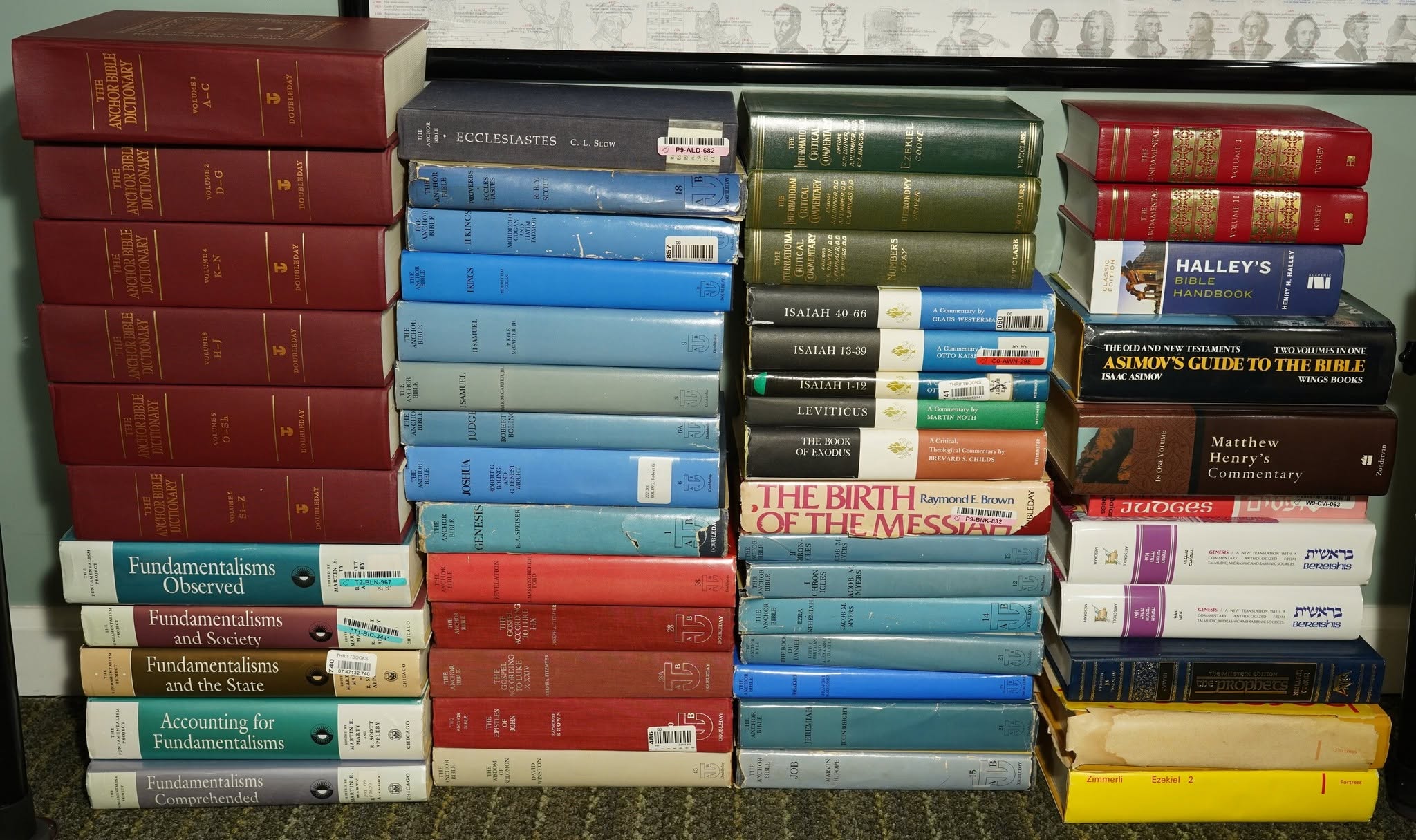
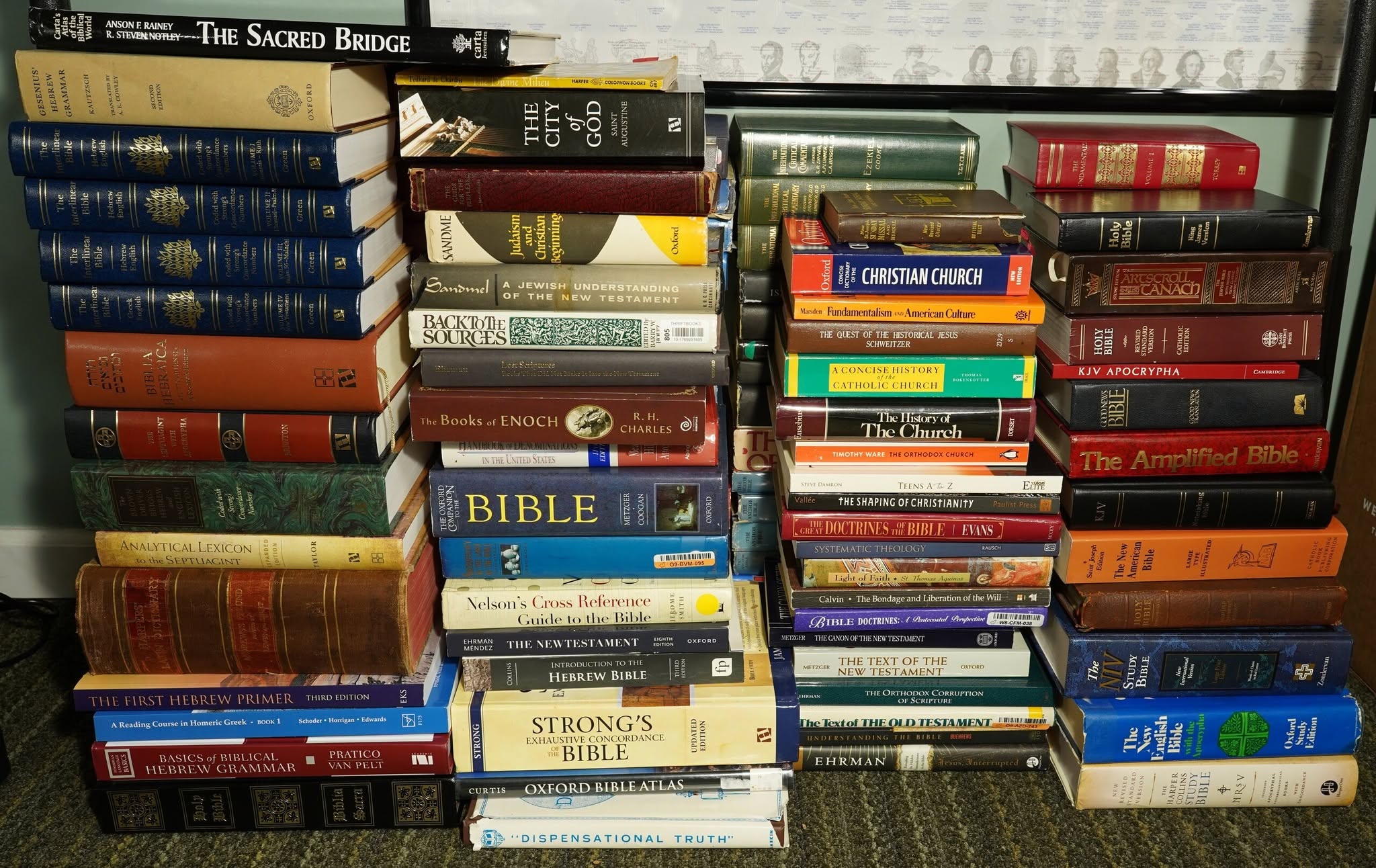
My collection of Fundamentalist/Christian/Bible related materials pulled from my personal library shelves--over one hundred and ten volumes--shown "in storage".
I haven't read most of these volumes (some of these, of course, are reference books), but of what I have read much has been fascinating; for me though, there are other fascinating materials on unrelated topics waiting to be read that I think would be more fulfilling.
--fin
58. Which books of the Bible to read first. - 23 December 2025
As I have posted previously, after some decades break I began reading the Bible again in January 2023. In 2023 I read the KJV. In 2024 I read the NEB with Apocrypha. In 2025 I read the Tanach (Jewish Bible), Stone Edition. Having been a Protestant Christian Fundamentalist back in the day and knowing first hand its harm, I was motivated by a desire to disillusion and free Protestant Christian Fundamentalists. I knew what broke me free--a theological matter of faith, grace, and fairness, but I felt the reasoning too esoteric to wield to others (except perhaps if there were any potential thinkers among them), so I began an effort to see what I could find that might lead to a break for them. And I feel I am at that point now--and as late as a month ago I did not know that here is where I would be.
I have been saying that one should read the Bible in order from Genesis to Revelation. After decades of feeling that way, in the past couple of weeks, I've changed my mind. To get a sense of what the Bible is (at an unappreciated angle) it is now my opinion that one should read the Song of Solomon and Revelation first to avoid becoming positively biased by other content and desensitized to the disquieting content in these books. Read the Song of Solomon and see the Bible is not as Holy as what folk might like to make it out to be. Read Revelation and see who Jesus is, and what he does to those who aren't his followers, when he has power.
I feel the Song of Solomon and Revelation are the "Elephants in the Room" when it comes to belief in the Bible as the "Literal Word of God". That is if one still holds to that notion after carefully reading them, their faith (see December 7 posting) is too obdurate to be unsettled by the presentation of facts and I am disinclined to believe that any other arguments I might present would work on them in the future. So, I've pulled my Fundamentalist/Christian/Bible related materials off the shelves--around a hundred volumes--and I am putting them in storage.
--fin
57. Bam! Bam! Fundamentalist notion of the Bible being the Literal Word of God shot dead by their own hand. - 17 December 2025
Bam 1: As seen in recent installments in "Secrets of the Fundamentalists", Fundamentalists do not take the Song of Solomon literally.
Bam 2: As seen in my posting of 3 March 2024, Fundamentalists perform contortions to salvage the notion of non-contradiction in the Bible to make sense of King Jehoram's youngest son, Ahaziah, being two years older than he (2 Chronicles 21:20-22:2). But in doing so, they demonstrate that the text cannot be taken literally.
Fundamentalists have been backing down from the view of Biblical preservation in recent years harkening back instead to texts as originally written; perhaps because of Bam 2 and similar difficulties. OTOH, Bam 1 leaves Fundamentalists with two unsavory options, remove Song of Solomon from the Bible, or, embrace erotic poetry in the Bible. What Fundamentalists universally do is a different option, just ignore the difficulty.
I want to stress that if the Bible is not the Literal Word of God, then it is subject to interpretation, and however strongly the Fundamentalists feel about their interpretation, it isn't "yea, verily, this is the Word of God", it is an interpretation, an opinion, which may actually be poorer than some alternative.
--fin
56. Canon of Scripture? (Part 3) - 13 December 2025
In Jesus' day, with the scarcity/unavailability of physical copies of the texts that made up the Jewish Bible (~Christian Old Testament) and widespread illiteracy (why do you need to able to read if your livelihood doesn't depend on it and there's practically nil material commonly available to read anyway) it really shouldn't be a shock to anyone today that various New Testament authors (whether oral or written) did not know the Jewish Bible as well as any of us can get to know it today if we make the effort.
--fin
55. Canon of Scripture? (Part 2) - 11 December 2025
My reading of the entirety of the Christian New Testament dozens of times leads me to believe that its authors were largely unfamiliar with the whole of what would come to be known among Christians as the Old Testament (I've also read dozens of times).
2 Timothy 3:16-17 (KJV)--"All scripture is given by inspiration of God, and is profitable for doctrine, for reproof, for correction, for instruction in righteousness: that the man of God may be perfect, thoroughly furnished unto all good works."
Believers of various stripes have their various collections of passages (sometimes referred to by critics as a "canon of the canon") that they use 2 Timothy 3:16-17 to undergird. But 2 Timothy 3:16-17 uses the word "all", so I think we need to consider "all". Take Nehemiah 3:14 (from my personal Bible reading today):
"But the dung gate repaired Malchiah the son of Rechab, the ruler of part of Bethhaccerem: he built it, and set up the doors thereof, the locks thereof, and the bars thereof."
Is there anything remarkable about this verse? I don't see anything. It's surrounded by verses that read very similarly. None of them stand out as remarkable (good or bad). It reads like a work report. (Okay, so God keeps track. Does he need to provide proof?) I contend that such is not out of place in a compendium of resource materials (see 54. Canon of Scripture?) for the learned few, but that the Lord God wanted to get these particular words to believers begs credibility.
Can you imagine Joe Fundamentalist using Nehemiah 3:14 as his signature (life) verse?
--fin
54. Canon of Scripture? - 9 December 2025
Despite what is believed by many believers, it is well known among objective scholars that the particular origins of most of the texts in the Bible are unknown. For a simple for instance, the author of the Gospel of Matthew is unknown--indeed, no claim of authorship is made in the text itself. ("We've got to call it something, it seems like it could've been written by Matthew, let's call it that.")
The research of objective scholars indicates that the Bible began as a compendium of resource materials for the learned few. As generations passed and the texts spread to devotees of less diligence and sophistication, folk's perception of the Bible morphed from being a resource for the learned few to being the authoritative Word of God. (You know, with the former, you expect some variation; with the latter, my oh my, did God contradict himself? Just saying.)
None of the believers that I know came to the belief that the Bible is the Word of God by reading it on an island. They got that belief from that culture that grew over time.
Objective scholars have written much on topics like these, for those who'd like more information I've read and can recommend these introductory college texts: Ehrman and Mendez's 𝘛𝘩𝘦 𝘕𝘦𝘸 𝘛𝘦𝘴𝘵𝘢𝘮𝘦𝘯𝘵: 𝘈 𝘏𝘪𝘴𝘵𝘰𝘳𝘪𝘤𝘢𝘭 𝘐𝘯𝘵𝘳𝘰𝘥𝘶𝘤𝘵𝘪𝘰𝘯 𝘵𝘰 𝘵𝘩𝘦 𝘌𝘢𝘳𝘭𝘺 𝘊𝘩𝘳𝘪𝘴𝘵𝘪𝘢𝘯 𝘞𝘳𝘪𝘵𝘪𝘯𝘨𝘴, and Collins' 𝘐𝘯𝘵𝘳𝘰𝘥𝘶𝘤𝘵𝘪𝘰𝘯 𝘵𝘰 𝘵𝘩𝘦 𝘏𝘦𝘣𝘳𝘦𝘸 𝘉𝘪𝘣𝘭𝘦.
--fin
53. The Emperor's New Clothes: Remarks on the book of the 𝘚𝘰𝘯𝘨 𝘰𝘧 𝘚𝘰𝘭𝘰𝘮𝘰𝘯. (Part 4)
To say one has knowledge in a substantive way is to say that ones belief is true and justified. Justification in turn consists of sensory data and human reason. Faith is belief without the justification of sensory data and human reason.
While absolute knowledge is an aspiration, knowledge generally is partial, which can be due to deficiencies in sensory data and human reason. As time goes along these generally build up among those who seek it, such as scientists, philosophers, and other researchers. As that happens, knowledge progresses and, quite naturally, displaces faith. That is, except for when those people who view their faith as paramount, where their faith arrests progress. This attitude can be known as traditionalism or conservatism.
As in all pursuits of knowledge, scientific investigations rely upon sensory data and human reason. These are what led to the understanding of Evolution. On the other hand, what has been unfortunately called, "Biblical Creationism", arrests any aspirations toward gathering sensory data and employing human reason in its demesne, except possibly as cherry-picked items that may be enlisted to support the Fundamentalist interpretation of the biblical text.
Benighted Fundamentalists apply a literalist interpretation to the Genesis Creation text. A common mantra of theirs being to "interpret what's in the Bible literally unless it's obvious that you can't" actually betokens a profound ignorance of scientific theory as well as what's in the Bible. For the former, consider Ernst Mayr's 𝘞𝘩𝘢𝘵 𝘌𝘷𝘰𝘭𝘶𝘵𝘪𝘰𝘯 𝘐𝘴, and for the latter, consider, the Bible's own 𝘚𝘰𝘯𝘨 𝘰𝘧 𝘚𝘰𝘭𝘰𝘮𝘰𝘯--wherein believers can't believe that the Lord God meant for it to be understood literally as written, that is as an erotic poem. It is the believers' sense of propriety which distances themselves from a literalist interpretation of the 𝘚𝘰𝘯𝘨 𝘰𝘧 𝘚𝘰𝘭𝘰𝘮𝘰𝘯; might they have a similar sense of science to distance themselves from a literalist interpretation of the first chapters of Genesis.
--fin
52. The Emperor's New Clothes: Remarks on the book of the Song of Solomon. (Part 3) - 30 November 2025
By its mere presence in the Bible, the Song of Solomon squashes the notion that what is written in the Bible must be understood literally. That being the case all understandings and proclamations of any Bible text are interpretations at best and anyone who says, 'this is the Word of God' on any topic, is presenting a human interpretation as God's sentiment.
--fin
51. The Emperor's New Clothes: Remarks on the book of the Song of Solomon. (Part 2) -29 November 2025
If the Song of Solomon is not to be interpreted literally, then it cannot be said that the Bible (as in the entirety of the Bible) is the literal Word of God. In places, like the Song of Solomon, it may be the allegorical (symbolic) Word of God (if that). As the Song of Solomon does not internally give indication that it is allegory, it is not to be expected that other Bible passages in the entirety of the Bible give indication that they are allegory either. There is no reason then to assume that the Genesis six day twenty four hour Creation account is literal (for example), nor indeed, that of any other particular passage in the Bible. Those depending on a literal interpretation for whatever text in the Bible they are concerned about do not have the basis they think they have. While many may regard the Bible as inspirational, it can not in any particular instance be relied upon to be literally true, and, yes, this includes passages that one is basing their world view, morality, and eternity on.
--fin
50. The Emperor's New Clothes: Remarks on the book of the Song of Solomon. - 27 November 2025
You remember the tale of The Emperor's New Clothes? A couple of con artists con all in a community to assert they see the emperor's splendid new clothes for fear they will outed as mentally deficient if they say otherwise. Eventually, an innocent, someone not concerned about community opinion, breaks the spell telling what he sees--or rather doesn't.
My daily Bible reading/study has found me this week in the Bible book of Song of Solomon. I have heard and read how supposedly spiritual this book is. I don't see it. There's no mention of God, God's people, God's word or anything else about God. No other book in the Bible demonstrably directly even references it. Frankly, it is a physically steamy passionate bit of text. Read it, see for yourself.
Despite the text's character, the Song of Solomon has been touted as a sublime spiritual book by faith leaders. And, all I can think of is, Really?
It seems to me that the presence of the Song of Solomon in the Bible is the clearest and best argument to question the assertion that the Bible (exemplified by the KJV) is literally the Word of God. Either that, or the question becomes why did God include an erotic poem in his word?
Did he just want to include an erotic poem so you could see he's a regular guy?
Or, like faith leaders say, it has to be taken as allegory as to God's relationship to Israel or the church (depending on your tradition)?
If the allegorical position is maintained, then that kind of throws biblical interpretation into a quagmire for biblical literalists, because if the allegorical approach is correct for the Song of Solomon, and the Song of Solomon is part of the Bible, then one has to be open to the allegorical approach elsewhere in the Bible. And the first thing that comes to my mind is the Genesis Creation account--you know, what the bible literalists say occurred in six twenty-four hour days. Admit that the Bible can properly be interpreted allegorically and that adamant science denying interpretation dissolves.
BTAIM, I don't see the Song of Solomon as allegory. I see it as something that got in the Bible--who knows how--and conservative faith leaders have been working hard to spiritualize/allegorize it to preserve/salvage the myth of viewing the Bible as the Word of God.
--fin
49. Remarks on the book of Job. - 22 November 2025
I've just completed my latest read of the book of Job (from the Jewish Bible/Christian Old Testament). From the first time I read it--as a teenager, until now, I find it a remarkable book, and today I would like to share with you some remarks on my read of it. My approach with this book, like any other, is to see for myself what is therein written, rather than conform my views to the notions of others.
1. Job 2:11 introduces Job's three interlocutors and until Job 32 all discussion is amongst Job and these three. Suddenly, in Job 32:2, out of the blue, a fourth interlocutor, Elihu, is introduced. It certainly seems to me that if Elihu had been there from the beginning, he would've been mentioned at the beginning. Furthermore, the narrative after he is done speaking makes no mention of him. Just seeing the evidence of my own eyes I'd say this was material added at a later date.
2. The Lord is said to speak to Job "out of the whirlwind" in 38:2. Honestly, to me, the phraseology here seems to me to indicate that the notions covered in the next few chapters are forming in Job's own mind, that's 'the whirlwind', rather than being asserted to be an articulated speech from the Almighty.
3. In Job 1, as part of a test of Job's faithfulness to the Lord God, Satan, with the Lord God's leave, kills Job's seven sons and three daughters. Job passes the test, and the Lord God gives him another set in Job 42:13. Really? Can one child replace another?
4. I've saved the most significant remark for last. The message from the Lord God from Job 38 on is that Job, as a human, can't understand what the Lord God is up to, so just leave it at that. Uncritical faith. Job is rewarded in the end (replacement kids and all). Remember though, humans ('good godly men') with fancy appearances and with fancy titles telling you what to believe determined what would be in the Bible and they have a vested interest in common folk not thinking critically for themselves.
Note, I am not setting myself as an authority, but rather endeavoring to encourage any and all to ascertain for themselves (think critically) what is written rather than uncritically accepting any authority.
--fin
48. Fundamentalism's dirty little secret - 18 November 2025
I would say that it is a common expectation of church goers that their pastor would have done his homework/due diligence on what he speaks. Seems reasonable, eh? But it can actually betoken an inclination to laziness on the part of those in the pews; viz., 'preacher has done the work, so, I don't have to. All I have to do is trust what he says.'
I've known a number of Fundamentalist leaders rather closely, 'behind the curtain', as it were, and the only homework I've observed them doing is refinement of the party line and implementation. There is an aversion to associations outside of their Fundamentalist community and a very strong aversion to anything that smacks of hard research, objectivity and thinking critically. When a Fundamentalist preacher says the Bible teaches something or other, it's actually generally what their faith community says ("good godly men"), and has said ("test of time").
I recently had interaction with a man in the Fundamentalist ministry who had shared a post. The post was incoherent--the text did not agree with the graphic. I did an internet search on the graphic and found the original reasoned article in which the graphic was coherent. I detailed it for him. He wasn't interested. He wasn't interested decades ago in another situation either. For this fellow, I think, he actually isn't capable of thinking critically and, of course, he has no conception of what critical thinking is. But he has thousands of followers, who trust him. What's up with that? I think it not unlikely that many followers can't imagine a "good" person putting themselves in a place of leadership and trust who has not done their homework, but what they are not thinking of is that this person's great faith and forceful persona is because of, and emanates from, a person who is actually missing a mental capability, that is, the ability to, and interest in, thinking critically. He acts like he's got it all together and that's why he's followed, but he's actually clueless, and that's why he leads.
A standard topic of scholarly discussion is that of 'faith versus reason'. I will say, while succinct, it isn't as meaningful as it could be. I will rephrase it as such: 'uncritical faith versus critical thinking'. If you believe what you believe because you have done a critical analysis, you have the latter. If you believe what you believe without having done critical analysis, well, what are you left with?
"If the blind lead the blind, both shall fall into the ditch." --Matthew 15:14 (excerpt) (KJV)
--fin
47. What's glaringly obvious about the Bible. - 10 November 2025
Back in the decades when I was in Fundamentalism it was taken as a fact that anyone who was right with God would see as glaringly obvious that the Bible is indeed the Word of God as it couldn't be imagined that an all powerful and good God would not share his word with us.
I have been at Secrets of the Fundamentalists since 3 January of this year (2025) and one of the points I continue to harp on is that if you truly want to approach being a Bible-believer (emphasis on believing the 'Bible') then you need to separate yourself from any faith community that takes it upon itself to tell you what the Bible says. The emphasis of this installment of Secrets of the Fundamentalists, however, is a bit different and relates to the opening sentence.
Earlier today, I was reading in the book of Job (for those believers who don't know it, Job is one of the books of the Jewish Bible, which Christians commonly refer to as the Old Testament) and was just kind of struck at how beneficial some of the (of course, human authored) footnotes are. Really. Think about it for a moment, God is all powerful, God is good, God gave us the Bible, yet we need some other humans to sort what he has written and afterwards tell us what he means? Couldn't he have written something we could understand without humans helping him out?
Of course, if God had made his Word clear, where would that leave all those whose livelihoods depend on interpreting it? Honestly, my aim here is not to lay any accusation of malfeasance on those so employed (although I know several who are), but rather to call attention to what seems glaringly obvious to me, that as powerful and good as God is, believers think that the book he wrote needs a lot of human help (God needs help?) to be understood.
--fin
46. Do believers really believe the Bible is the Word of God? (Part 2) - 1 November 2025
When I posted on this topic, "Do believers really believe the Bible is the Word of God?" last week in installment 45 I was thinking of the Fundamentalists I knew twenty years ago. That has been weighing on mind since, since I know that those who would have been Christian Fundamentalists back in the day are largely the Christian Nationalists of today. Among the parts of the Bible that I was thinking about that the Christian Fundamentalists would rather not think about were those approving of the literal slaughter of other human beings merely on the basis of being different. The attitude of Christian Fundamentalists back in the day was that their mission was to seek to make individuals Christian through the Gospel. OTOH, Christian Nationalists in the present are largely seeking to make the land look Christian through political means. I think that many Christian Fundamentalists back in the day would have been appalled by the shift in focus.
Christian Fundamentalists mostly would have recognized that acting like a Christian does not make one a Christian and could actually conceal that any particular person was in need of Christ. Christian Nationalists seem to not care.
But what about my allusion to literal slaughter in the Bible earlier? You know, if the Bible condones such, then actions not as harsh as that have to be allowed (too) which could be summarized as favored status for believers, or put another way, oppression of unbelievers. And, not to belabor the point, but really, the Christian Fundamentalist Gospel presentation that I am familiar with and used myself a multitude of times back in the day (decades ago), threatened the unbeliever with the worst possible fate: eternity in a literal Hell. Additionally, let it not be forgotten that when various Christian groups gained absolute power they were quite willing to slaughter those who believed differently, in some cases even though it was merely a different form of Christianity.
--fin
45. Do believers really believe the Bible is the Word of God? - 26 October 2025
Wouldn't it seem to you that if you have a book that you feel is unquestionably God's Word that it would be your highest priority to see what God has to say? And, wouldn't you feel it an act of hubris to cherry-pick the parts that you will regard of God's Word consequently ignoring the rest? Yet, for the most part, those who claim to believe the Bible don't make an effort to read it front to back and of those who do read it, they routinely tune out large swaths of it--many times with a rubric that God's words are too high to be understood. However, the Bible also states that all scripture is given by inspiration of God.... Hmm. It is my argument that the tuning out of troublesome passages is not because the words cannot be understood, but rather because the words can be understood! It's the ramifications of that understanding that (self-professed) believers find unsettling as it undermines what the believer believes their God and His Book should be like. So, rather than face the facts of what the Bible is, they imagine it to be what they'd like it to be. Did someone say cherry-picking?
--fin
44. On Martin Luther - 25 October 2026
I've made a point of stating how my life had changed in reading Browne and Keeley's Asking the Right Questions: A Guide to Critical Thinking. I've also shared how the excitement I felt about thinking for myself led me to go back to school to further develop my critical thinking processes by pursuing a Master in Arts in Philosophy degree at Cleveland State University (awarded in 2003). But, I don't remember mentioning that there was still one question that I had that I felt unanswered--a question that I felt I had to answer before I could pause graduate studies. That question was, Why did folk believe in the kind of religion that I had believed? Honestly, at that time I was prepared to continue graduate studies leading to other degrees until I got an answer. After my MA in Philosophy I found myself taking courses in Social Psychology and the History of Reformation Europe--as the most promising--and I actually loved them! But, I withdrew! Why? Well, unlike the Master of Arts in Philosophy where I had targeted the degree's attainment, with these courses it was set on getting a particular question answered--and it was!
Among the required reading materials for the History of Reformation Europe were English translations of matter actually written by Martin Luther. They were quite the revelation. Protestant Christians may imagine that Luther's motivation for his "protest" against the established church (what is today known as the Roman Catholic Church) was analytically motivated, but what came across loud and clear to me was that Luther had a very troubled mind and his motivation was to assuage his inner torment rather than dispassionately ascertain the content of the Bible--witness, for example, his well known willingness to pitch those parts of the Bible that didn't conform to his ideas.
Christians today, of course, thankfully, are not all contemporary imitations in varying degrees of the seriously troubled Martin Luther. Religion is not felt so deeply. But the question I have for those who are devotees of faiths as Luther spawned, have you looked into this man--or others like him--to see what he or they were like? Can you really disassociate the person from the religion they founded, that is, the religion you follow? I assert that you can not. Their personal demons did not lead them to an objective read of the Bible, but a cherry-picked selection salving their particular troubles.
--fin
43. The Constitutional Concoction of Christian Nationalism. - 13 October 2025
When I set out on this particular exercise on the philosophical underpinnings of Christian Nationalism, I sought the best book-length treatments that I could identify from the for- and against- viewpoints. The works I identified were Mark David Hall's 𝐷𝑖𝑑 𝐴𝑚𝑒𝑟𝑖𝑐𝑎 ℎ𝑎𝑣𝑒 𝑎 𝐶ℎ𝑟𝑖𝑠𝑡𝑖𝑎𝑛 𝐹𝑜𝑢𝑛𝑑𝑖𝑛𝑔?: 𝑆𝑒𝑝𝑎𝑟𝑎𝑡𝑖𝑛𝑔 𝑀𝑜𝑑𝑒𝑟𝑛 𝑀𝑦𝑡ℎ 𝑓𝑟𝑜𝑚 𝐻𝑖𝑠𝑡𝑜𝑟𝑖𝑐𝑎𝑙 𝑇𝑟𝑢𝑡ℎ and Andrew L. Seidel's 𝑇ℎ𝑒 𝐹𝑜𝑢𝑛𝑑𝑖𝑛𝑔 𝑀𝑦𝑡ℎ: 𝑊ℎ𝑦 𝐶ℎ𝑟𝑖𝑠𝑡𝑖𝑎𝑛 𝑁𝑎𝑡𝑖𝑜𝑛𝑎𝑙𝑖𝑠𝑚 𝑖𝑠 𝑈𝑛-𝐴𝑚𝑒𝑟𝑖𝑐𝑎𝑛, respectively. I have now completed my read through of these two works and will herein state my primary takeaways.
1. On the Constitution of 1789, Christian Hall concedes that the text is secular. Secular Seidel stresses that the text is secular. I recently reread it, it is secular. Read it and see for yourself.
2. Secular Seidel's viewpoint is that the Constitution should be read as written. Christian Hall's viewpoint is that the Constitution should be read imputing it with Christian feeling which was representative of the majority of folk of the day. These viewpoints are known as 'Textualist' and 'Originalist', respectively.
But what I say is, What justification is there to read Christianity into a document--as the 'Originalists' do--that the Founders so carefully explicitly excluded Christianity from when so many other documents of the day exhibited no such restraint? How would you feel about folk who read what you had written who feel the impulse to impute to your document some perspective of some set of folk in a different context rather than what you had so thoughtfully set down?
The Constitution (as amended) is the Supreme Law of the Land and, in consideration of the above, I consequently confidently opine that attempts to read into the original document Christian doctrine are benighted and an insult to the Founders' intention.
--fin
42. On Bible-belief and Interpretation - 5 October 2025
Fundamentalists take a potpourri of Bible passages as inspirational. Those found commonly in a community of faith have been, of course, cherry-picked through the years. The problem here is that the sense they have is that these cherry-picked passages convey the sense of what the Bible in its entirety has to say. Such a disposition toward not reading the entirety of the Bible from Genesis to Revelation for oneself, but rather depending on preachers and other faith leaders, leads one to be led wherever they choose to lead rather than seeing for oneself and making that determination for oneself. And, you know, who is actually doing the shepherding may be humans one has not actually met, but be layers removed from the preachers and other faith leaders one does know. Indeed, the preachers and other faith leaders one knows may be just as in the dark as those sitting in the pews.
I have suggestions for those interested in getting toward what the Bible has in it:
1. Read the Bible in order from Genesis to Revelation. Don't focus on the good and tune out the bad--yes, the Lord God killed or had killed an awful lot of people.
2. Repeat reading the Bible in different versions.
3. Stop going to church, or, visit all kinds of churches.
4. On passages that interest you, check out one of the websites that lists dozens of versions and see what they say.
5. Read books and articles offering a wide range of interpretations on the Bible--don't neglect those written by unbelieving scholars.
But note, this observation:
"The road to atheism is littered with bibles that have been read cover to cover." --Andrew L. Seidel, The Founding Myth, p. 112
--fin
41. On the use of the word: "Atheist" - 27 October 2025
I. I hope that whatever your persuasion that the following can be agreed to as common usages:
a. believing that God exists: Theist
b. not believing that God exists: Atheist
II. I suggest that many individuals who identify as, or are identified as, atheists, are such because their reason has not been convinced of God's existence or (stronger sense) has been convinced of the non-existence of God. As such I posit:
a. belief in reason: Rationalist
b. not believing in reason: Irrationalist
III. If we are going to talk about what II. a. who happens to be I. b. should be identified as 'believing' I'd say it is Rationalist rather than Atheist as these are 'Beliefs' rather than 'Not-beliefs'. On the other hand, if some quarter insists on the term, Atheist, then Irrationalist would in the same sense be applied to them as both are Not-beliefs. I don't think theists would like this even if they are people of Faith. Rationalists, however, should consider carefully whether they want to accede to a loaded term which defines themselves only in relationship to theism.
IV. This is not to say that theists do not reason, rather the consideration is which is dominant, faith in God or exercise of Reason.
--fin
40. A towering Christian's feeling toward the unconverted. - 21 September 2025
Jonathan Edwards and his sermon of 8 July, 1741, 𝗦𝗶𝗻𝗻𝗲𝗿𝘀 𝗶𝗻 𝘁𝗵𝗲 𝗛𝗮𝗻𝗱𝘀 𝗼𝗳 𝗮𝗻 𝗔𝗻𝗴𝗿𝘆 𝗚𝗼𝗱, are person and text most identified with the Great Awakening--a period when Christianity experienced a reset, a reset to a form of Christianity that was all if anything centered on conversion without reflection--get saved now, because you are not guaranteed another moment.
I first read the sermon in public high school--where it was assigned reading! Recently though a bit was pointed out to me that I kind of forgot about, the attitude of the Christians toward the unconverted (note the italics).
"Thus it will be with you that are in an unconverted state, if you continue in it; the infinite might, and majesty, and terribleness of the omnipotent God shall be magnified upon you, in the ineffable strength of your torments. You shall be tormented in the presence of the holy angels, and in the presence of the Lamb; and when you shall be in this state of suffering, 𝘵𝘩𝘦 𝘨𝘭𝘰𝘳𝘪𝘰𝘶𝘴 𝘪𝘯𝘩𝘢𝘣𝘪𝘵𝘢𝘯𝘵𝘴 𝘰𝘧 𝘩𝘦𝘢𝘷𝘦𝘯 𝘴𝘩𝘢𝘭𝘭 𝘨𝘰 𝘧𝘰𝘳𝘵𝘩 𝘢𝘯𝘥 𝘭𝘰𝘰𝘬 𝘰𝘯 𝘵𝘩𝘦 𝘢𝘸𝘧𝘶𝘭 𝘴𝘱𝘦𝘤𝘵𝘢𝘤𝘭𝘦, 𝘵𝘩𝘢𝘵 𝘵𝘩𝘦𝘺 𝘮𝘢𝘺 𝘴𝘦𝘦 𝘸𝘩𝘢𝘵 𝘵𝘩𝘦 𝘸𝘳𝘢𝘵𝘩 𝘢𝘯𝘥 𝘧𝘪𝘦𝘳𝘤𝘦𝘯𝘦𝘴𝘴 𝘰𝘧 𝘵𝘩𝘦 𝘈𝘭𝘮𝘪𝘨𝘩𝘵𝘺 𝘪𝘴; 𝘢𝘯𝘥 𝘸𝘩𝘦𝘯 𝘵𝘩𝘦𝘺 𝘩𝘢𝘷𝘦 𝘴𝘦𝘦𝘯 𝘪𝘵, 𝘵𝘩𝘦𝘺 𝘸𝘪𝘭𝘭 𝘧𝘢𝘭𝘭 𝘥𝘰𝘸𝘯 𝘢𝘯𝘥 𝘢𝘥𝘰𝘳𝘦 𝘵𝘩𝘢𝘵 𝘨𝘳𝘦𝘢𝘵 𝘱𝘰𝘸𝘦𝘳 𝘢𝘯𝘥 𝘮𝘢𝘫𝘦𝘴𝘵𝘺."
They'll know we are Christians by our love?
--fin
39. MISSING. (I am guessing I never used the number 39.)
38. Christian Nationalism challenge. - 13 September 2025
In my last post (see it) I observed that Christian Nationalism has seemed to supersede (Protestant) Christian Fundamentalism. This post is a follow-on.
I am expecting delivery of two books today that will be at the top of my near term reading list:
1. 𝐷𝑖𝑑 𝐴𝑚𝑒𝑟𝑖𝑐𝑎 𝐻𝑎𝑣𝑒 𝑎 𝐶ℎ𝑟𝑖𝑠𝑡𝑖𝑎𝑛 𝐹𝑜𝑢𝑛𝑑𝑖𝑛𝑔?: 𝑆𝑒𝑝𝑎𝑟𝑎𝑡𝑖𝑛𝑔 𝑀𝑜𝑑𝑒𝑟𝑛 𝑀𝑦𝑡ℎ 𝑓𝑟𝑜𝑚 𝐻𝑖𝑠𝑡𝑜𝑟𝑖𝑐𝑎𝑙 𝑇𝑟𝑢𝑡ℎ by Mark David Hall
2. 𝑇ℎ𝑒 𝐹𝑜𝑢𝑛𝑑𝑖𝑛𝑔 𝑀𝑦𝑡ℎ: 𝑊ℎ𝑦 𝐶ℎ𝑟𝑖𝑠𝑡𝑖𝑎𝑛 𝑁𝑎𝑡𝑖𝑜𝑛𝑎𝑙𝑖𝑠𝑚 𝐼𝑠 𝑈𝑛-𝐴𝑚𝑒𝑟𝑖𝑐𝑎𝑛 by Andrew L. Seidel
Hall's book argues for Christian Nationalism and Seidel's book argues against. Both books are touted as written by scholars and are highly regarded by their respective camps. It's my intention to carefully read them in turn and evaluate the arguments around Christian Nationalism for myself.
Who will join me in a careful (independent, no skimming or speed-reading) reading of these two books? Surely, if you want to be fair about the matter, you need to hear from both sides.
--fin
37. This series, Secrets of the Fundamentalists, is winding down. - 12 September 2025
It seems I may be twenty years late in talking about Protestant Christian Fundamentalism. My limited observation is that many of the churches that were, or would have been, Fundamentalist twenty years ago, is that their emphasis has changed from fealty within the church to the Fundamentals to rather imposing their worldview on the nation. This new emphasis is aggressive and so isn't something that its adherents keep low key, so I will just say that it is Christian Nationalism.
(You know, I had been wondering why I hadn't been getting more pushback on my posts in this series, I think it's because Fundamentalism has been left behind by its erstwhile adherents.)
One of the manifestations of change, not necessarily the most important one, is the open embrace of handguns into the church culture. Did you know that churches are having drawings with prizes of Bibles--to be expected, but also handguns? I have nothing against handguns per se (I myself have participated in league shooting), but the notion of Christian militancy (Onward, Christian Soldiers!) takes on a new significance when church promotes weaponry.
Of course, many of these folk feel that the world belongs to Satan, and anyone not with them is against them, and wishes them dead--and they will point to cherry-picked Bible passages to support that view. So much fear, hate, anger, ignorance!
As I have expressed previously, believers really should read the whole Bible through-and-through and not base their views on cherry-picked passages. But the best course of action is to adopt critical (reflective) thinking practices. Critical thinking won't dictate to you what to believe or not, what to practice or not, but it will help you evaluate what you are presented with. If you feel you've got everything worked-out, you need to get into Critical Thinking. If you feel the time for reflection is past, now is the time for action, you need to get into Critical Thinking.
Recommended reading: Browne and Keeley's Asking the Right Questions: A Guide to Critical Thinking.
--fin
36. "Among the blind, the squinter rules." - 22 August 2025
The above quote is a Latin proverb per Erasmus and is, I think, appropriately applied to Fundamentalism. Among Judeo-Christian leaders, I have found no group less knowledgeable about the Bible and Judeo-Christian history than they. At the same time I have found no group more convinced of the superiority of their knowledge of the Bible and insight of world affairs. This is well known and documented by researchers outside of Fundamentalism, but, inside of Fundamentalism, the sheep are even more ignorant (frequent church services help keep them in the dark), and the leadership who has glommed onto very select bits of the Bible (less than one percent) seem to the sheep to be towering founts of Biblical truth. They all say they hold forth the Biblical way of Salvation, but as they know so little of the Bible and Judeo-Christian history, really, how can that be the case!
--fin
35. Where have the Fundamentalists gone? - 17 August 2025
I left Fundamentalism nearly twenty-five years ago. It is clear that the church (congregation) that I had been a member of has also left Fundamentalism. Furthermore in my research of other Fundamentalist churches from back in the day, per their current websites, three of four:
1. have backed away from the dogma of King James Version of the Bible (KJV) inerrancy
2. make no mention of the Six Day Creation or Six Thousand Year Old Earth
3. refer to the 'Virgin Mary' but do not refer to the miracle of the Virgin Birth
The fourth still stands for the inerrancy the KJV, but tellingly has withheld making any statement on the other points.
My hypothesis is that with the rise of the Internet, folk now can find out about most churches are about through their respective websites. Low-information persons have been a historic prey of Fundamentalism, but the Internet and even church websites can change that. And churches themselves can change when they recognize through cross-pollination that their views don't actually have the foundations that their naive forebears were quite certain of.
So, if Fundamentalism is on decline, where does that put my series on 'Secrets of the Fundamentalist'? Well, you must remember that my core objection to Fundamentalism has been and remains that it is hostile to 'critical thinking' (AKA, 'reflective thinking'). The prime factor in my own emergence was having read Browne and Keeley's 'Asking the Right Questions: A Guide to Critical Thinking'. Maybe I need to focus more on the presentation of Critical Thinking--that's what worked for me, after all.
It has been lamented in the literature that Critical Thinking is neglected in formal education and individual development. I find the current trend toward private Christian schools moving in the wrong direction. Ostensibly these are intended to instill Christian values, and I have no doubt that is their agenda, but rather what should be taught is how to think critically so that one can make determinations for oneself.
--fin
34. 'How Religious Fundamentalism Hijacks the Brain' - 9 August 2025
This week I am deferring to another. Bobby Azarian, Ph.D., is a cognitive neuroscientist and science writer. His article, "How religious Fundamentalism Hijacks the Brain: Fundamentalist ideologies act like mental parasites" was posted to the Psychology Today website on October 10, 2018. I found it a few years ago in my own research on Fundamentalism and consider it quite insightful. I am sharing it now because of a recent DM received which brought to my attention that some folk may think of Fundamentalism as just another religion--just another set of beliefs. As Azarian's article argues, what it is goes way beyond that and should be troubling to all.
Here's the link: https://www.psychologytoday.com/.../how-religious...
--fin
33. Vacation Bible School (VBS) - 2 August 2025
Fundamentalist Vacation Bible School is not like what you may think it is, about the joy that comes from studying the Bible, but it is rather a highly refined operation that Fundamentalists have been working on for generations to get children to convert to Fundamentalism. And, you know what? That commitment a child makes at age eight can last them the rest of their life. That's the Fundamentalist goal. Is that what you want, before the child can discern wheat from chaff?
--fin
32. Why I am anti-fundamentalist. - 26 July 2025
I realized when I de-converted from fundamentalism twenty years ago that the things I absolutely had to believe as a fundamentalist bound my mind and squashed my freedom to think critically. In summary I said, If this is what you have to be to go to heaven, I don't want it.
--fin
31. And what does the Bible actually have in it about the 'Virgin Birth'? - 19 July 2025
1. Today's installment is on the 'Virgin Birth'. If you want to see everything the New Testament (NT) says about the Virgin Birth check out Matthew 1:18-25 and Luke 1:26-38. Those two passages are it. There aren't any others.
=========================
It has been asserted that Isaiah 7:14 is a prophecy of the Virgin Birth. However,
2. Whereas the KJV has the word 'virgin', the passage was originally written in Hebrew, and the word in Hebrew (from the Masoretic Text that was generally used as the basis of the KJV) is not the one to be used for 'virgin', but rather 'young woman'.
3. The Septuagint, an earlier Greek translation of the Hebrew, does use the word for 'virgin'. In the Greek Orthodox tradition the translation is considered inspired.
4. When read in context of the surrounding text in Isaiah, Isaiah 7:14 is talking about a contemporaneous woman's duration of gestation. The prophecy's fulfillment is less than nine months away rather than the centuries until Jesus' birth.
5. Matthew 1:23 appears to be a quotation from Isaiah 7:14, but Isaiah is not actually mentioned by name.
=========================
6. Fundamentalists typically do not mention the Virgin Birth in their presentation of the Gospel. That is, in practice, belief in the Virgin Birth is not viewed as a necessary condition to be saved/born again.
7. No NT works of John mention the Virgin Birth.
8. No NT works of Paul mention the Virgin Birth.
Yet,
9. Fundamentalists have been blanketing parts of the world with booklets combining the gospel of John and the book of Romans on the notion that these are the most essential texts to read from the Bible. These texts contain no mention of the Virgin Birth.
I lay out these points so that those interested may perform their own examination and form/review their own opinions. Fundamentalists claim to believe the Bible and that indeed is who this installment is for as well is the rest of this series. Those in other Christian faith traditions may believe in the Virgin Birth because of creed or church dogma--they are not a part of my focus, but they are certainly welcome to consider.
--fin
30. No, fifteen minutes is not enough. - 13 July 2025
I've heard it said among Fundamentalists that doctrine (read: dogma) should not be based on the New Testament book of Acts. The feeling is that Acts recounts a period of significant change in the way the Lord God deals with the world. This includes some special "acts" that were necessary for the germination of the church. That being said, the account of "Philip the Evangelist and the Ethiopian Eunuch" from Acts 8:26-39 is generally held among Fundamentalists as an encouragement to go and do likewise.
Briefly, the account tells of Philip approaching the Ethiopian Eunuch (EE) who is reading from the book of Isaiah (what would become part of the Christian Old Testament). Philip asks if he understands what he is reading to which EE says how could he, he needs someone to guide him.
(At this point let me interject that the book of Isaiah is one of the longest and most complicated books in the Bible. That EE was challenged by it is no surprise.)
The passage that the account focuses on is Isaiah 53:7-8. The Acts account here, like much of what is found in the Bible, is nothing more than a thumbnail sketch. Doubtless there was a conversation that lasted long enough for the EE to convert and seek identification with the Christianity by initiation through baptism. However, many Fundamentalists take it that this thumbnail sketch depicts how conversion can take place in little more time than it takes to read about it--uh, maybe fifteen minutes.
The problem with a fifteen-minute interpretation is that while a conversion of some sort may occur, it will be, as it were, in shallow ground--the person doesn't understand enough for it to actually take root.
Another troubling aspect of the fifteen-minute interpretation is that it is fundamentally hostile to doing ones homework. With it one gloms onto a verse or two, accepts some nice sounding explanation, clap their hands together and feels relief that a time-consuming and challenging task has been avoided.
Really, if one wants to approach Isaiah 53:7-8 properly (or any Bible excerpt), one needs to do so in context, and at the very least that means reading the surrounding text, but beyond that, to be thorough, reading the rest of the Bible and other materials that will offer a sense of the Bible in context with the world then, now, and in between. That is a major effort that can take many years. I don't mean to imply that it is something that folk need to do, but rather, it is illusory to say that a 'teaching' of the Bible can be distilled down to a manageable quantity of verses that someone can convey to you in fifteen minutes.
--fin
29. See/hear/read for yourself-->think for yourself! - 5 July 2025
My primary aspiration for humankind, that is for each individual, is to develop their minds to think for themselves. For Fundamentalists my approach has been to contrast what they fancy themselves to believe, that is that they are Bible-believers, against what is actually contained in the Bible as any individual reading it for themself would see it for themself. In this I have kept saying in my postings that you can't honestly say that you believe the Bible if you haven't actually carefully read it for yourself cover-to-cover. However, I must acknowledge that it seems among a significant portion of the population there is little inclination to actually read much of anything.
You'd be hard pressed to find a Fundamentalist who did not own a leather-bound Bible that they always take to church; it's doubtful though that very many pages actually see the light of day at much any other time. This is not meant to point out any hypocrisy on their part, but rather to show, what? Lack of enthusiasm among the 'faithful'? Confidence in their leaders? A disinclination to read?
If we grant the last of these speculations, it would seem a plausible alternative to actually having a book printed on paper or an e-book to cast ones gaze at, an alternative would be to listen to an audio book version of the Bible. So say, when you're in your car, mowing the lawn, washing dishes, etc. you are hearing what is therein written. Indeed, I am saying, if you can't bring yourself to use your eyes to read it, use your ears.
And, I am also going to say, if you really want to understand what is going on in the Bible, you should start by reading the oldest books first. For instance, you've probably heard of Jesus' Parable of the Good Samaritan (in the New Testament), but do you know why the Jews of Jesus' day despised the Samaritans? If you'd already read the Old Testament you'd know from the book of II Kings the origin story of the Samaritans, how the Ten Lost Tribes of Israel got lost, and how the Jews got to be called such--they're all connected and you really should know this stuff when you read the New Testament or listen to your preacher.
So, my plea, for Fundamentalists is to ingest the Bible as it is written--by sight or sound--and my hope in your so doing is that you will see it as it is rather than as you've heard it said to be and that you will liberate your thinking in so doing. Adjust your beliefs according to what is there rather than interpreting what you imagine is there according to your beliefs.
--fin
28. Just like any other self-respecting Fundamentalist I had a 'testimony' of my conversion experience. - 28 June 2025
I am a Cleveland, Ohio native and was brought up in a neighborhood United Methodist Church. I don't have much to say about that church except when Billy Graham held his July 1972 crusade in Cleveland the minister was enthused about getting membership to attend. It didn't seem to effect me much, but the minister 'got saved' as did some of my teen peers. Well, it got to bothering me when some of my peers started voicing opinions of what the Bible said as fact. While I felt my peers' opinions were deficient, I felt my own knowledge of the Bible was lacking and so I started reading it, alternating between Old and New Testaments.
I was not an unbiased reader. I came into my reading feeling the Old Testament was more agreeable with its code of works than the New Testament with its notion of faith. Be that as it may, I always began my reading praying that God would 'show me the true way in a way that I could understand'. And, you know what? It happened, or so I thought for the next twenty-some years.
Specifically, I read Habakkuk 2:4 which says:
"Behold, his soul which is lifted up is not upright in him: but the just shall live by his faith."
This was exactly what I was looking for. And it is therein that lies the problem. One verse out of twenty-three thousand some in the Old Testament and I base my acceptance of the entire Bible on that! But this acceptance is flawed.
1. I had no appreciation for the context of the verse within the book of Habakkuk.
2. I had no appreciation of the book of Habakkuk's place within the Bible.
3. Establishing that there is a notion of faith in some context within a single book of the Old Testament does not in any way make an endorsement for the New Testament.
As I've probably mentioned before, faith in a context as used here is synonymous with belief. Belief is merely one component of 'knowledge'; the other two are 'justification' and 'truth'. In a sense, to say that one has faith is to say one is lacking in the justification and/or the truth aspects that would constitute knowledge. And, of course, it is simple-minded to say that knowledge is either you have it or you don't proposition; it's dependent (in part) on how much justification you have. But saying you have faith in something is so is to disclaim any pretense of having any justification and ergo any knowledge.
--fin
27. Does the Bible say (fill in the blank)? - 21 June 2025
The closest that one can come to saying that the Bible says something is to actually fill in the blank by the whole text of the Bible. It should be clear that any selection is less than what 'the Bible' says. It should also be clear that whoever made the selection has left their imprint in that they decided what the selection should be.
So, of the two following statements, Which is more persuasive? Which is more accurate?
1) The Bible says you must be saved!
or
2) Fundamentalists have interpreted four or five select and separated verses in the Biblical book of Romans to say you must be saved.
Which would a carefully honest person state? Which would a Fundamentalist use?
More Secrets to follow.
--fin
26. Salvation, once again. - 14 June 2025
This week, multiple of my fundamentalist Facebook friends have parroted variations of the fundamentalist notion of salvation. These recent postings have amounted to citations of less than ten Bible verses each. A classic paper tract of theirs I have in hand has around twenty. They all claim that what they are saying is what the Bible is saying. In a sense they are right, of course; in another sense they are not.
Fundamentalists will say that as all the Bible is the Word of God one needn't know any of the rest of the Bible and these are sufficient to be definitive on the notion of salvation. However, using that logic, it would seem one could select entirely different verses and say then that such alternatives have equal claims to validity even though conflicting. With over 31,000 other verses in the King James Version of the Bible there's plenty of material for alternatives. As mentioned in previous posts, most of the Old Testament (the oldest verses) treats death as the end of one's individual existence, and many of Jesus' words in the New Testament treats the Afterlife as determined by Good Works rather than a Sinner's Prayer.
I am not saying what anyone should believe about the Bible, what I am saying is that if you claim to believe the Bible, and you want to be honest about it, you really need to have studied all of it.
And another point, if the fundamentalist notion of salvation is from the Lord God, and He wants it made known to all, why'd He make such a puzzle of it to find in the Bible that you would need a fundamentalist to show you the location of each of the verses?
--fin
25. Wonder of Creation. - 6 June 2025
The beginning chapters of the book of Genesis are a favorite of many Fundamentalists. I confess as I have read scholarly discussions on same, reread the chapters, and discussed with others, to being positively Awed by the content of these chapters. But, speaking as a former Fundamentalist, it is something that a Fundamentalist can't even have an inkling of because they are stuck with, what shall I call it?, a seven year old's way of interpreting the Bible? (My apologies to precocious seven year olds.)
For instance, Creation to the Fundamentalist must have occurred in six sequential 24 hour days. What can I say? The way the account is written it is something that can be understood by a seven year old according to a seven year old's understanding; but as they grow they can come to understand that the intended message is not about a 144 hour Creation but rather the Wonder of the Lord God's creation. Days here don't have to be 24 hours; they don't even have to be sequential, the account is about Wonder rather than a timeline.
More Secrets to follow.
--fin
24. Understanding the Bible. - 31 May 2025
Honestly, when I was a Fundamentalist, I recall preachers challenging parishioners to read the Bible, and at times even offering schedules to read the Bible through in a year. Sigh, if only the sheep would do so.
I remember one of the established teachers of adult Sunday school in an introspective moment commenting how--perhaps--he should read the Bible more and pray less . . . See what the Lord God has to say to him more rather than getting the Lord God to listen to him.
But it seems the fact of the matter is that Fundamentalists treat the Bible lightly. The flock reads little and thinks the Holy Spirit will guide them when they need it even though they are unaccustomed to reading it. But what's to be expected when the shepherds routinely show a god-awful disrespect of the Bible when they willy-nilly grab passages from hither and thither and cobble together a sermon to make it appear that a private notion is actually the Lord God's Word?
The path to understanding higher mathematics requires many years of study. The path to understanding the Bible requires no less study. Feeling that the Lord God will provide Bible understanding after fifteen minutes of prayer or even a thirteen week Bible home-study course is the height of presumption. In reality, it is a lot of hard work and a reason I do it is so I know the hooey of false claims made about the Bible--it's not a path for everyone.
More Secrets to follow.
--fin
23. A parable: Sam meets Uncle Mortimer - 23 May 2025
Sam passed into Eternity having been a faithful Fundamentalist . . .
He was surprised to find the Afterlife wasn't at all what he expected. He found himself in front of an ornate desk being interviewed by someone of heavenly mien who went by "Uncle Mortimer".
Sam: This isn't at all what I was expecting.
Uncle Mortimer: What were you expecting?
Sam: Well, what the Bible says.
Uncle Mortimer: Have you read the Bible?
Sam: I read it all the time.
Uncle Mortimer: But have you actually read all of it?
Sam: I can't say 100%, but my preacher has and he tells us all we need to know about it.
Uncle Mortimer: Yeah, that's pretty much the story with Fundamentalists. Over a life you read scattered bits and pieces. You claim to believe the Bible, but you haven't actually read it yourself and checked up on your preacher and you get here and find out it isn't like they said. Your preacher has cherry-picked what he wants you to hear and the stuff he hasn't shared would make a difference.
More Secrets to follow.
--fin
22. Who does Fundamentalism appeal to? - 17 May 2025
A favorite New Testament passage of Fundamentalists is Ephesians 2:8-9 (KJV): "For by grace are you saved through faith; and that not of yourselves: it is the gift of God: Not of works, lest any man should boast."
Whatever the author of this passage's intention, the Fundamentalist would say that (heavenly) salvation is not the result of work--you can't earn it. BTAIM, in exercise, the Fundamentalist feels that God's grace extends to those who haven't actually done their 'homework' to understand what it is they are believing. A few Bible verses, pamphlets with cartoons, etc. are sufficient. And so,
I assert, Fundamentalism appeals to folk who want freed from the burden of actually having to do their homework on the subject of salvation.
More Secrets to follow.
--fin
21. If Fundamentalists really believe the Bible, why do they circumscribe Bible study? - 11 May 2025
When first exposed to Fundamentalism I was struck by the fact that my Fundamentalist church was against Bible study discussion groups. In the Fundamentalist Bible study groups I witnessed the only person talking was the Fundamentalist leader.
So, a few days ago, I met up with some Tri-C Encore participants. In part, the Bible was discussed. Wonder of wonders, comments were made that made sense of the Genesis creation narrative that I hadn't heard before.
1. Genesis 1:27 tells of the creation of man, and, Genesis 2:7--also--tells of the creation of man. Friday's interlocutor shared that the first occurrence may have been Cro-Magnon man, and, the second occurrence, modern man, that is man in possession of a soul or consciousness. Wow, but a Fundamentalist would never get there, because the Fundamentalist is stuck with a six day creation.
2. Genesis 2:21-23 tells of woman's formation. Anyway, Friday's interlocutor told of how among primates, humans were exclusive in their males not having bacula. Wow, but a Fundamentalist would never get there, because the Fundamentalist imagines only one kind of rib.
The foregoing strengthens my case for discussing the Bible with folk of diverse viewpoints. That Friday's interlocutor was a Jew, strengthens my argument that Jewish scholars understand the Hebrew Bible (Old Testament) better.
More Secrets to follow.
--fin
20. Is Salvation as simple as ABC? - 3 May 2025
As a Fundamentalist, I was a True Believer. I attended three church services a week plus Sunday School (I even taught), I sought out opportunities to preach, and I spent hours every week knocking on doors in anticipation of sharing the message of Salvation with the Lost who may be within. There was much more, but you get the idea. Anyway . . .
It was held in the greater community of faith to which I belonged that you could see the Lost come to a saving knowledge of the Lord Jesus Christ in under fifteen minutes by presenting select portions of Scripture. Indeed, I saw plenty of conversions based on no more than that.
Really?!
Would you commit to buying a house, or a car, or even a refrigerator, from some pup parroting some random (as far as you know) clippings from who knows where? But you are doing worse, much worse than that, when you decide to commit to the Salvation as presented by Fundamentalists, because you could replace the house, car, or refrigerator, but with this Salvation you've decided to conform your mind (Convert) to this way of thinking.
And, be aware, that Conversion does not mean Salvation.
A critical bit the pups tell you, that just isn't true (it's a 'secret'), is that as all the Bible is the Word of God, you don't need to be concerned about the rest of what it says. Pure BS.
As I've written before, check it out for yourself; I seek not being a leader, I seek being a goad to urge you to see for yourself.
More Secrets to follow.
--fin
19. Does the New Testament reveal what the Old Testament conceals? - 26 Aprilc 2025
The notion of the statement, "The new is in the old concealed; the old is in the new revealed", is one that has been shared by Protestant Christian Fundamentalists usually without an appreciation of its source. Among historians the source is identified with Augustine of Hippo who Wikipedia identifies as Bishop of Hippo Regius, Church Father, Doctor of the Church, Blessed. He lived from 354 to 430 and much of Christian thinking had its first articulation with him.
The first, most obvious thing to note with Augustine's theological statement here is that its origin outside of the Bible. The origin is human. The origin is Augustine.
The second, is that the statement simply cannot be self-evident for most folk. If one makes this statement without having actually studied the entire Christian Bible, one is merely parroting what one has been told. I venture to say that most Fundamentalists--including preachers--haven't even read the Old Testament beginning to end.
Third, if the Old Testament is 'concealing' things, it is doing so in a very significant way. Take for instance in regards to an Afterlife. You see, throughout the vast majority of the Old Testament physical death is most decidedly the end of life. I will assert this is not a concealing but a distinctly different position.
More Secrets to follow.
--fin
18. On what day of the week does the Bible state Jesus was crucified? - 19 April 2025
Most Christian scholars believe that the Bible teaches that Jesus was crucified on a Friday ('Good Friday'). Some, but by no means all, Fundamentalists believe that the Bible teaches that Jesus was crucified on a Wednesday ('Bad Wednesday'). What do I think? I think it doesn't matter what I think. What I do think is that if this question is of interest to you, next time you read through the New Testament make a note of all texts mentioning the crucifixion and see what you come up with and do a little research besides.
I will say, and it isn't gratuitous on my part, that the notion that the Bible is a single book rather than a collection of works is a dogma (Fundamentalists eschew the work 'dogma', and prefer 'doctrine', but they mean the same thing) and acts as an impediment to actually seeing what is therein written. Don't believe me, do some research and see how the content of the Bible was actually determined.
Getting back to the Bad Wednesday versus Good Friday question, what I witnessed at my Fundamentalist church of decades past was Dr. xxx preaching that the crucifixion had to be on Wednesday because it was clear if you did the arithmetic back from Sunday (the Resurrection) for three 'whole' days and nights like Jonah in the whale's belly you'd be at Wednesday. (They think) THIS IS SO CLEAR! Ha! This is low hanging fruit. Anyone in the Fundamentalist pew could understand it. Other passages were complicated and Fundamentalists don’t want complicated. A problem, of course, with this Fundamentalist interpretation being whether the 'plain' language of the English version represents the intention of the author in the original. But Fundamentalists can't be troubled with such notions--another 'secret' of the Fundamentalists is that the English can be used to CORRECT the originals and scholars can be dismissed as untrustworthy--they don't have the Spirit of God and that keeps them from accepting what plainly is the Word of God! Ha!
Dear Fundamentalist, don't let the Fundamentalists' secrets keep what is actually in the Bible secret from you.
More Secrets to follow.
--fin
17. What kind of movement is Fundamentalism? - 12 April 2025
Ostensibly, Fundamentalism, that is, Protestant Christian Fundamentalism, began as a movement about a century ago to focus belief on the Bible. The tactic to do so was to make up a list of those beliefs (articles of faith), the Fundamentals, that were the essentials for (true) Bible belief. The list was as short as five items and today some Fundamentalists have as many as twenty-some in a list. The exact number and what these beliefs are is of secondary importance. What is of primary importance as far as Bible-belief is concerned is that the list makers have taken it upon themselves to decide/dictate what you should believe of the Bible. They may make a big deal of such things as what the Lord God says in one place in the Bible being clear that it should be used to interpret other places, so you don't need to worry about it--but that is a construct of theirs. If you want to target being a Bible-believer there is no substitute for actually doing a careful independent study oneself. Sure, you can read other materials, but get a variety of viewpoints from their best scholars.
Recently I saw a Facebook exchange among Fundamentalist leaders expressing enthusiasm over meeting up with various political leaders. Once again, ostensibly, Fundamentalism was concerned with the salvation of individual souls and afterwards godly behavior would follow. Today, (much of) Fundamentalism has gone over hard to imposition of its moral values on the general population. This imposition is akin to the dictation of belief above. Moral reasoning can be a complex subject. What should be realized that as a complex subject what a person may feel to be a self-evident truth, "X is wrong!", may no longer appear self-evident truth once you start to really look at it.
Fundamentalism is a movement of control. Control of belief through the Fundamentals and, especially today, control of behavior by political means.
Fundamentalists have become so conditioned that they can't imagine that their choices are not limited to picking who they are going to follow; but there is another choice, that is to think for oneself and encourage others to do so.
More Secrets to follow.
--fin
16. What is Faith? - 5 April 2025
I’ve heard some Fundamentalists assert that faith is defined by Hebrews 11:1; while others vehemently deny that is the case. For reference the text from the KJV is:
"Now faith is the substance of things hoped for, the evidence of things not seen."
Without word-chopping, it certainly seems that the verse is saying that there is nothing to it, except wishful thinking . . .
That being the case, once again, I ask, why don’t those who profess belief in the Bible actually read it; that is with comprehension? Remember how I mentioned before that it seems the ideal for Fundamentalists, rather than being thinking/rational grown-ups, is to be as children, as sheep, and as rocks?
Amongst philosophers, that is those who are rigorous about thinking about thinking, knowledge is defined as justified true belief. Faith, in the context of this short essay, is belief--merely one of three components. (It could also be a religious practice, etc., but those are different uses of the word and not considered here.)
1 John 5:13 (KJV) leads many to believe that belief (faith) is sufficient to attain knowledge:
"These things have I written unto you that believe on the name of the Son of God; that ye may know that ye have eternal life, and that ye may believe on the name of the Son of God."
But note, there is a blatant circularity in the verse: these things have I written unto you that believe on the name of the Son of God - - - that ye may believe on the name of the Son of God! Let’s just get stuck in this loop! And, apparently, that is how you know–just keep at it over and over again rather than considering the (rational) justification and its (objective) truth.
And you wonder why Fundamentalists go to church three times a week, have annual revival meetings, as well as Bible and prophetic conferences, and, have their own schools where they repeat the same old stuff?
More Secrets to follow.
--fin
15. When the going gets tough, the tough get going. - 30 March 2025
From time to time--including the present--I have written and posted exhortations to individuals who feel it within themselves to profess to believe the Bible, to actually read the Bible for themselves rather than as sheep blindly following their Fundamentalist leaders. My target audience has been those who are like I was, capable of thought and reason but somehow deluded by Fundamentalism who perhaps just need a little kick to get to thinking for themselves.
I have had some Facebook Friends in Fundamentalist leadership positions. You would think that being tough as they imagine themselves to be, they would stick around and as time to time rolled along they would with calm assurance be able to point out to themselves the flaws of what I had to say and feel strengthened in their position and perhaps share the superiority of their views with others. Some perhaps have. Others, well, I did use the past tense.
More Secrets to follow.
--fin
14. Who wrote the Gospels? - 22 March 2025
The question comes down to whether one is going to believe what is actually found written in the Gospels or rather what post-biblical persons theorized in the early centuries of Christianity–that the authors were certain persons named Matthew, Mark, Luke and John. In case you don’t know it, no names are associated with authorship anywhere within the actual Gospel texts–they are anonymous.
Today there is abundant scholarship dealing with such things as the background, education and skills that the Gospel authors would have to have possessed and the unlikelihood that unlettered Aramaic-speaking Jews such as Matthew, Mark and John could write in Greek. Some of the fundamentalist tradition have claimed that God just gave to the illiterate alleged-Gospel authors the ability to write their Gospels on the spot via a miracle. If we accept authorship as being anonymous, this incredible fundamentalist notion loses its motivation.
I will grant that it is convenient to continue calling the Gospels by the traditional names of Matthew, Mark, Luke and John, but knowing what is in the actual Bible text and what isn’t should enable one to better regard it.
More Secrets to follow.
--fin
13. Fundamentalist Conceit. - 15 March 2025
My own sense from observation and study is that it is common among Christian sects that each has its own traditions. Fundamentalism is not an exception in this regard. What is different about Fundamentalists is that whereas other sects freely (honestly) recognize and acknowledge their traditions as being the lens through which they interpret the Bible, Fundamentalists have the conceit that they faithfully conform their beliefs to the entirety of the Bible.
Believing parts of the Bible, Fundamentalists will tell you, is not believing the Bible, but only parts. BTAIM, they aren't really any different than the rest. To spotlight their own practice I pose the following illustrative rhetorical question: Would a Fundamentalist take literally the Old Testament passages plainly contrary to the notion of an afterlife? Hmm, Of course not!
It’s their conceit that they are the faithful (and true) Bible-believers as what distinguishes Fundamentalists here from other Christian sects rather than any superlative (and impossible) faithfulness to the (entirety of the) Bible.
More Secrets to follow.
--fin
12. Patriotism. - 8 March 2025
Of course, what is meant here is American Patriotism.
It would seem that if Fundamentalism were as they claim it to be, a Bible-believing movement, there would not be a Patriotic dimension to the movement as Christians did not 'discover America' until over a millennium after the last of the Bible had been written.
Yet there is a strong overt 'Patriotic' sentiment running through Fundamentalism. But what is the nature of this sentiment? The Christian school that my former Fundamentalist church started decided to identify with the image of an American Revolutionary era 'Patriot'. Strange, why not some Bible, Christian or neutral choice? And, why, if feeling a 'Patriotic' sentiment, land on a Revolutionary character rather than on a nation building character? And, why encourage its student body to embrace the ethos of Revolt? Is Fundamentalism a political movement?
More Secrets to follow.
--fin
11. Hell. - 1 March 2025
A belief in a literal everlasting fire-and-brimstone Hell for unbelievers may not be found on every Protestant Christian Fundamentalism's published list of Fundamentals but there are quite a few things commonly held in Fundamentalism not generally put in print but there anyway. Many of these flow from the Fundamental of divine authorship and inerrancy of the Bible (in English, historically usually the King James 'Authorized' Version). We could call these derived fundamentals, but, they are no less part of the orthodoxy.
The problem with whatever the particular fundamental is, its authorship was human--it is an opinion of what is written in the Bible. The only claim to these being Bible-beliefs is the conceit of fundamentalists feel as being the arbiters of what the Bible intends.
As I have alluded to in the past, one can't even have a tenuous claim to being a Bible-believer without being quite familiar with it from scrupulously reading the whole thing--as it is written. The fundamentalist notion that certain passages can stand in place of a comprehensive familiarity of the Bible is a blind which keeps individuals from seeing all that is there.
Among things believers don't see is that the notion of an Afterlife (and the places to spend it) developed over the time the Bible was written. In ~95% of the Old Testament (OT) life ends at death--no afterlife. This is an easy study to do, just read the OT and note the passages--I did it two years ago.
So, what about this Hell thing then? It's an interpretation of writings from late in the OT, the New Testament, and other writings. The fine point is that it is an interpretation. A careful scholarly reading will be something other than a literal everlasting fire-and-brimstone Hell for unbelievers.
What is the motivation for such an interpretation? Reaching back to the time of Jonathan Edwards and the Great Awakening the motivation was to convince individuals of the absolute necessity to convert at the moment as the Lord God viewed each non-convert as a loathsome insect (~1741, 'Sinners in the Hands of an Angry God') He was ready to let drop into the fires of hell. 𝘋𝘰𝘯'𝘵 𝘵𝘩𝘪𝘯𝘬 𝘢𝘣𝘰𝘶𝘵 𝘪𝘵, 𝘫𝘶𝘴𝘵 𝘥𝘰 𝘪𝘵!
Perhaps, it was unseen by Edwards, but such an imperative selects for folk whose decisions are based on imperatives rather than a careful weighing of all available information. Now, combine that with a belief in a literal everlasting fire-and-brimstone Hell for unbelievers and what do you get? Us/them... The saved/the damned... Polarization? Why should the Fundamentalist feel any better about the unbeliever than what the Lord God feels?
More Secrets to follow.
--fin
10. Lack of imagination. - 22 February 2025
You know, I don't have an outline for the progression of these Secrets of the Fundamentalists. Much of the work I had done back-in-the-day as an aerospace engineer was new, it was for a research center after all, which suited me well--I think--as my modus operandi for my own tasks would be to start out with the simple sketch of how I thought things might go, try it out, and then develop something more sophisticated and better from there.
There were engineers who I worked with who felt they could see how their whole project should progress. More power to them, maybe it was because my particular efforts were less settled and more leading than theirs. I dunno.
Anyway, I don't have an overarching outline for dealing with Fundamentalism. Indeed, some of the concerns that I have with Fundamentalism spill over into other -isms extant today.
Among these is a lack of imagination. Last week I wrote on Follow the Leader. Many Fundamentalists, and others, seem to be locked into the idea that who they are is determined by who they follow. WWJD?? For many the evaluation is whose leader is better rather than the evaluation of the sense of each of their assertions. BS.
Unfortunately, Fundamentalism has set Fundamentalists up for susceptibility to a paradigm of followership rather than to that of individual evaluation of stances. Be that as it may, those of a professed more intellectual bent (and I consider myself an intellectual), sometimes we become so anti-Anti-intellectual that we succumb to the same sort of thing. We must not neglect our higher-Angels, and, we must approach all notions intellectually--put our 'thinking caps on', and not fall into followership or some simple-minded anti-followership either.
More Secrets to follow.
--fin
9. Follow the leader. - 16 February 2025
What distinguishes Fundamentalism (specifically, Protestant Christian Fundamentalism)--generally or superficially--is professed allegiance certain articles of faith which are referred to as 'The Fundamentals'. There are certain modes of 'thinking', say paradigms, that are as much a part of Fundamentalism as the Fundamentals, maybe even more so because the Fundamentalists are largely unaware that they are not universal but rather a choice. Today I will mention one.
Follow the leader. Fundamentalists like to think of themselves as 'Bible-Believers', but generally speaking, all their belief generally consists of believing what their pastors say is the Bible is the Bible. For the Fundamentalist in the pew being a Bible-Believer is having chosen a leader who claims to be a Bible-Believer--it does not involve independently thinking in regards to the Bible. It is a 'the leader does the thinking for all' kind of attitude.
I've heard it preached how the flock is responsible to follow the pastor's leadership and then the pastor is responsible to God. This is just one paradigm in Fundamentalism that squelches the thinking of individual Fundamentalists.
More Secrets to follow.
--fin
8. The Anchor Bible Dictionary - 9 February 2025
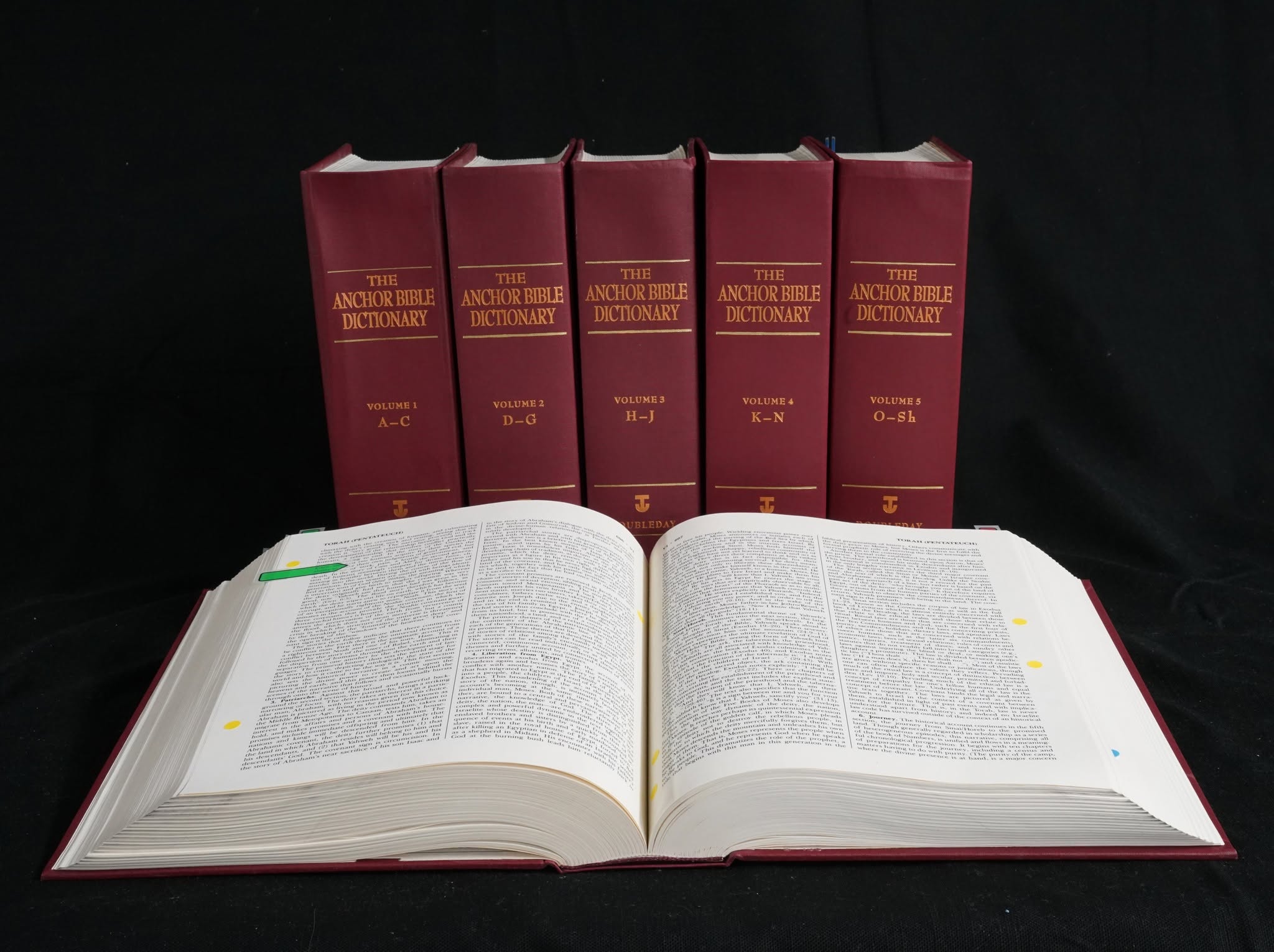
The Anchor Bible Dictionary (ABD) is a scholarly encyclopedic resource of Bible-related topics. Its 7035 pages are contained in a six volume set which weighs over 25 pounds. Many articles go into more detail than one might imagine, but each presents a bibliography for further study. It's a handy ready reference for anyone who would like to get grounding in any of the topics it covers.
I am very pleased that when I was in the market for a personal copy of the ABD in 2024, one became available regionally that I subsequently purchased. Since that time I've read over four hundred pages distributed about many articles. For the image, I've opened volume six to a page where you can see I am employing my by now standard method of placing removeable-sticker dots and flags at places of interest.
So, what does the ABD have to do with Fundamentalists? Well, the only evidence that this set was not new was a previous owner's signature in the first volume. The one who sold me the set was a subsequent owner who volunteered that in his many years of owning it, he only used it once and that was to look up some unfamiliar term. So, indeed, it appears that Fundamentalists really don't have much to do with the ABD or, I'd say, scholarship in general.
More Secrets to follow.
--fin
7. Formerly Fundamentalist? - 2 February 2025
So, I just found out this week, that the Fundamentalist church I had belonged to twenty-plus years ago has moved away from its self-identification as being a KJV Fundamentalist church. From a recent visit, I saw a sequence of wall posters in the front hallway depicting a history of the Christian Bible. Wow! An interest in history! These, I think, are moves in a positive direction.
Fundamentalism has been about conversion without contemplation. One converts and ones mission becomes seeing others converted (kind of a viral mechanism) rather than doing the digging to review/understand the data or even just review/understand the Bible itself to see what is actually written.
More Secrets to follow.
--fin
6. Would-be Zealots in Fundamentalism. - 25 January 2025
(All Bible texts from the King James Version.)
Back in the day, from time to time, scattered here and there among the thousands of sermons I heard him preach, I remember my broadly esteemed fundamentalist pastor Dr. * * channeling Paul in a lament,
"I have fed you with milk, and not with meat: for hitherto ye were not able to bear it, neither yet now are ye able." (1 Corinthians 2:3)
And just as Paul doesn't hint at what the meat is, nor did Dr. * *, it seems it was just a bit of rhetoric to launch into a diatribe toward the sheep. But--in either case--Was it?
A little later in the same chapter Paul states,
"Which things also we speak, not in the words which man's wisdom teacheth, but which the Holy Ghost teacheth; comparing spiritual things with spiritual." (1 Corinthians 2:13)
This particular verse has been used by fundamentalists as a "proof text" to support the notion
that any text in the Bible can be called into service to interpret any other text in the Bible. With this notion in mind, consider what Paul states later in the book,
"Now all these happened unto them for ensamples: and they are written for our admonition, upon whom the ends of the world are come." (1 Corinthians 10:11)
For many fundamentalists the idea expressed here applies to the Old Testament. One may say, well, Jeffrey, of course it does, What else could it refer to? But I push back, to what and in what way in the Old Testament? Among the denominations, Protestant Christian Fundamentalists are not renown for Biblical scholarship--their focus is set upon the Fundamentals (supported by a miniscule percentage of Bible text) and speedy conversions (because the world could end at any instant). With that backdrop in mind, what message might a zealous fundamentalist feel when confronted by the following Old Testament passage?
"And, behold, one of the children of Israel came and brought unto his brethren a Midianitish woman [...] And when Phinehas, the son of Eleazar, the son of Aaron the priest, saw it, he rose up from among the congregation, and took a javelin in his hand; And he went after the man of Israel into the tent, and thrust both of them through, the man of Israel, and the woman through her belly. [...] And the Lord spake unto Moses, saying, Phinehas, the son of Eleazar, the son of Aaron the priest, hath turned my wrath away from the children of Israel, while he was zealous for my sake among them, [...] he shall have [...] the covenant of an everlasting priesthood; because he was zealous for his God[.]" (Numbers 25:6-13)
Set aside whatever message the writer might have intended for the reader or how it should be read, my concern here is for how the would-be fundamentalist zealot might ingest it. For instance, might he/she not feel, wouldn't it be great to be rewarded as Phinehas was rewarded? Now, I can't think of any Protestant Christian Fundamentalists running through mixed (believing/not) couples intimately occupied, but the number who would squash such behavior (and many others) through whatever means they could is legion.
Not milk.
More Secrets to follow.
--fin
5. Are Fundamentalist Churches Bible Believing? - 18 January 2025
The shortest and most direct answer is that the vanguard of Protestant Christian Fundamentalists believes in Bible texts that support a set of Articles of Faith, their so-called "Fundamentals". There is way more to the Bible than texts that are related to these Fundamentals; as such, at most they can assert they believe those texts that support their Fundamentals.
As to what the Fundamentals are, one can check Wikipedia--which rehearses a list of the original five (from early in the Twentieth Century); on the other hand, the Sword of the Lord today lists 27, albeit not identified as such, but as 'Articles of Faith'; and, local churches may have their own list, such as my former church which added to the 'usual' 'doctrines' a few that the pastor had of his own.
Whatever a particular Protestant Christian Fundamentalist church's Fundamentals are one should note that what primarily distinguishes their 'Fundamentals' from other churches' 'Articles of Faith' is merely the name. If one carefully reads The Handbook of Christian Denominations in the United States by Mead et al, one will see that nearly all Christian churches allow no self-determination in belief amongst their membership with respect to their articles of faith and each asserts their beliefs as those that are true to the Bible and essential for approval by the Lord God.
There are many Christian denominations and they each have had their own founders and thought leaders. These individuals may have each believed the Bible in their own ways. But their churches are made up of a membership that bleats to their tunes. As such a church cannot be Bible Believing--only individuals can attempt to be Bible Believing and that only if each individual studies the Bible for themself without someone up front beating out the tune.
Sermons are a means to fill persons' heads with the feel good notion that they are hearing the Word of God, but what is presented is scant and cherry-picked to present an orthodox view. To comprehend the Bible ones time is much better spent reading the Bible as it is written.
More Secrets to follow.
--fin
4. Whose world is it? - 10 January 2025
I've mentioned before how when I was age eight my mother began walking me, my brother and sister to Peoples United Methodist Church. I remember sitting in my little chair at a short table with other children for Sunday School class. I have forgotten much, but I remember the booklets we put coins in for the offering, the pins we got for attendance, and, most movingly, I remember ole' Mrs. Johns with her snugly gathered salt-and-pepper hair and granny glasses in her tremulous gossamer voice leading us in song:
This is my Father's world,
And to my listening ears
All nature sings, and round me rings
The music of the spheres.
This is my Father's world:
I rest me in the thought
Of rocks and trees, of skies and seas--
His hand the wonders wrought.
(Maltbie D. Babcock (1901))
Y'know, I remember having a sense of God's immanence singing that song as a child. He was present in the world and I could feel him. (Cf. Immanuel -- God with us.) I can still feel that.
- - - - - - -
Unfortunately, I think the transactionalism that Fundamentalism has foisted upon the world ('Do A, B, C and be saved.') and its nihilism ('Heaven is my home.') has for many stifled the experience of the world as alluded to by Babcock above.
More Secrets to follow.
--fin
3. Sermonizing in Fundamentalism - 7 January 2025
During my score or so years as a True Believer in Fundamentalism I attended church regularly three times a week. That's about three thousand sermons (ugh!). That's quite a lot of time with each sermon generally lasting from thirty minutes to over an hour. Add to that, because I was a true believer, the recorded sermons I listened to, the sermons I heard in Bible Institute, and the sermons I read, that's a lot of sermons!
I want to make a couple of observations on sermons.
1. Nowadays, I would concur with this snippet from Wikipedia:
In informal usage, the word sermon is used in secular terms, usually disapprovingly, to refer to "a long talk in which someone advises other people how they should behave in order to be better people".
2. But perhaps more enlighteningly from an article in MovieMaker magazine that refers to feature length film versus shorter indie documentary projects:
"weak and diluted longform work aimed at soaking up [] time or selling them something."
= = =
In multiple instances I have received feedback from FaceBook Friends asserting that I would be benefited by listening to this or that sermon/homily/testimony (SHT). My first inclination is to say I have heard all this before. But my more considered response is to say that sermons start out with a few simple points which the sermonizer then adds a considerable amount of padding. The contrast between my postings and sermons is that whereas I spend hours creating a five minute posting, sermons start with (charitably, at most) five minutes of content and expand it to however long it is.
So, if you feel there is some insight in that compelling SHT that you want me to note, do what I would do for you, write it out. If you can't, what does that say?
More Secrets to follow.
--fin
2. Books in my Personal Library about Fundamentalism - 5 January 2025
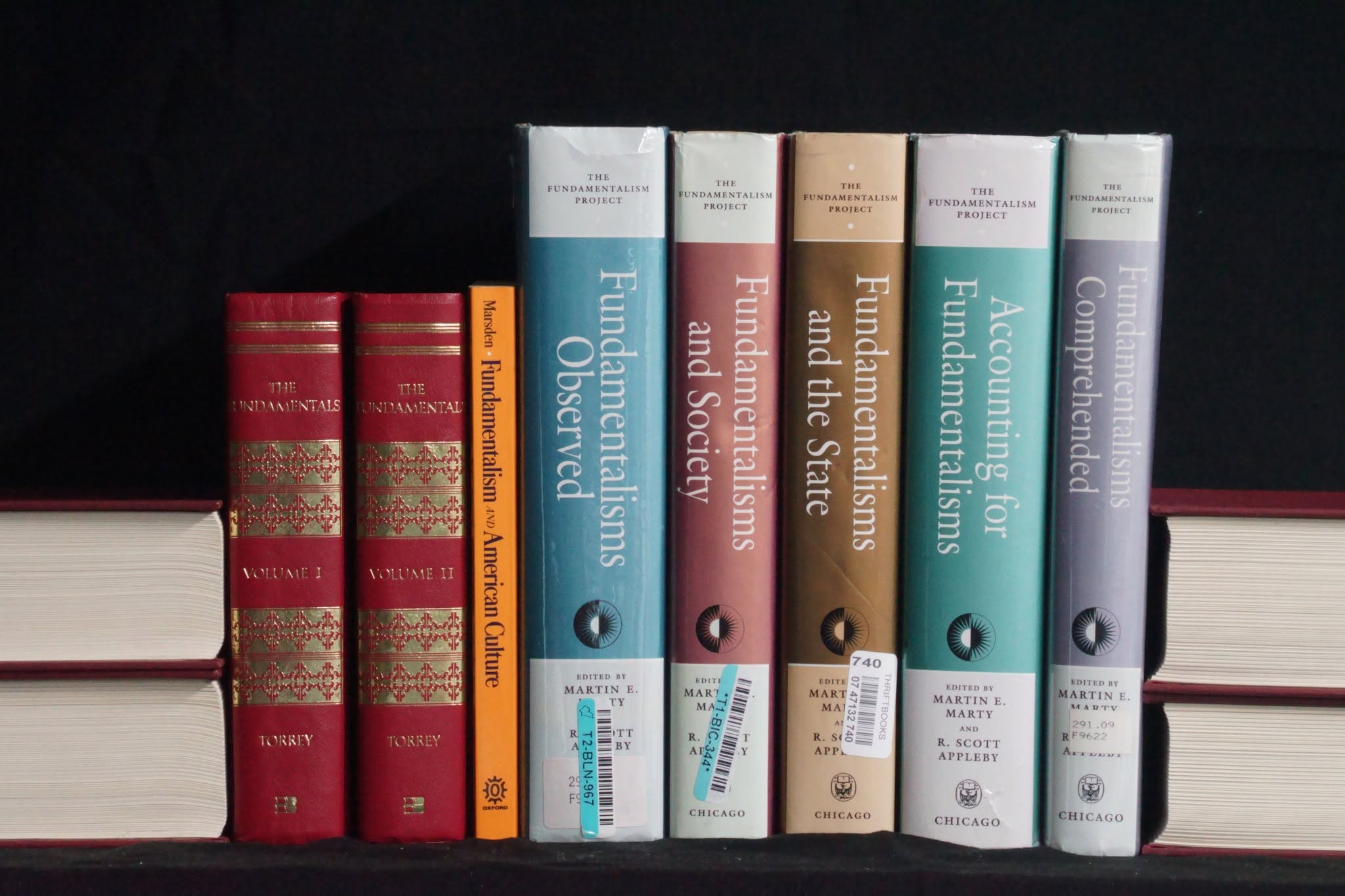
Fundamentalism actually arose fairly recently (as history goes). It was from 1910 to 1915 that installments were released to what would become known as 'The Fundamentals' to Christian workers at no to little cost. It is from the collection's title that Protestant Christian Fundamentalist movement got its name, Fundamentalism. It was the first fundamentalist movement and predates other religious fundamentalisms.
Fundamentalism developed as a reaction to modern man's objective research and scholarship in areas such as science, history, language and the Bible over the fear that folk's faith in some handed down beliefs was threatened by such modern practices. Fundamentally, what characterizes fundamentalism is unquestioning belief to some set of beliefs (AKA, articles of faith) and eschewing any research, including that of the individual, that might lead contrarily. BTAIM, some men somewhere determined what the Fundamentals are and over time continue to tweak the list.
---
I read The Fundamentals (ed. Torrey) in 2023 (two red volumes at the left in the image), Marsden's Fundamentalism and American Culture in 2000, and Fundamentalisms Observed (ed. Marty) also in 2023. The other Fundamentalism Project books await. The primary purpose of my posting this installment is to let you know that a literature of fundamentalists (e.g., Torrey) and about fundamentalism (e.g., Marsden and Marty) exists and you can look at these things for yourself.
More Secrets to follow.
--fin
1. The Doctors of Fundamentalism - January 2025
In my late teens I became distressed by the claims about what the Bible taught made by my peers at the lite church (Methodist) I belonged to. I didn’t know much about the Bible then, but it was plain that what almost anyone that I knew said about the Bible did not align with what they pointed to. By my early twenties I had come to feel that I would like to more formally help folk not to be deceived–by self or by others–as to what was actually in the Bible versus what was being made up.
As it happened the city’s preeminent Fundamentalist church had started a Bible Institute and was starting classes shortly. The institute was conveniently close, inexpensive and met in the evening, but for me the two clinchers were that the pastor of the church/founder of the institute was a “Dr.” and the ministry was “Bible-believing”. This posting touches only on the first of these.
Dr. * *’s Dr. was an honorific bestowed on him by Fundamentalist peers–men of generally similar position and background in the same community of faith. It was only years after my having drunk the sugary drink that I found out that Dr. * *’s Dr. was such an honorific and that he had only a three-year Bible school education and that merely on how to be a preacher. It was by no stretch of the imagination a degree in theology.
---
In Fundamentalism the honorary doctorates are generally bestowed to those who have contributed to the advancement of Fundamentalism. Perhaps looking at it in this simple-minded way the Fundamentalist honorary Dr. may be thought to not be that different from that of a credible University bestowing an honorary doctorate, but one should consider that in Fundamentalism the achievement is merited by increasing membership rather than for advancing the state of knowledge. It is worth noting that in regular academia, recipients of honorary doctorates do not usually prepend their names with Dr. like they do in Fundamentalism as if they had earned it–that would be considered misleading.
Putting Dr. in front of a Fundamentalist’s name without any academic basis has been common practice in Fundamentalism for scores of years–Dr. * * is far from unique and it is still going on. It is one of the Secrets of the Fundamentalists.
If you are so inclined to look it up, consider Jesus’ admonitions to other prefixed persons in Matthew 23 of the Christian New Testament.
More Secrets to follow.
--fin
===============================================================================
Check out my Facebook page for all of them as they originally appeared including images.
Best regards,
Jeffrey
email: Secrets-of-the-Fundamentalists@jrlee27.net